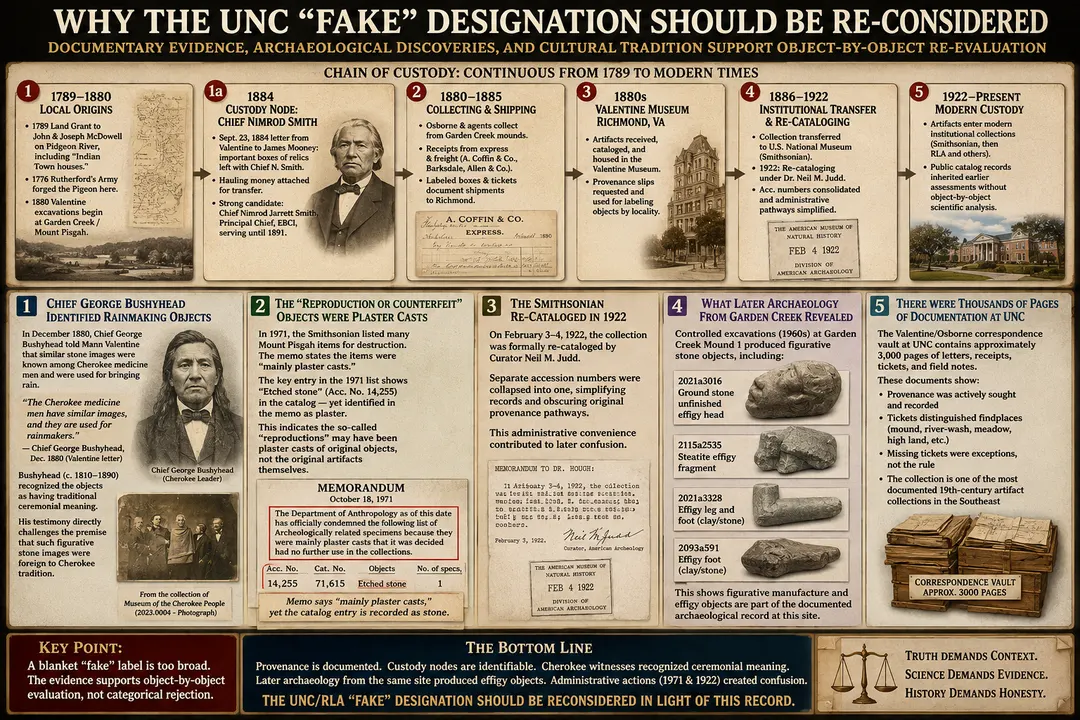

We respectfully petition UNC's Research Laboratories of Archaeology to reconsider the blanket "fake" designation applied to the Garden Creek/Mount Pisgah carvings and, pending review, replace it with neutral wording such as "authenticity disputed" or "historically described as fake."
The surviving record documents genuine nineteenth-century collecting, not that every carving was fraudulently made or that any specific carving is prehistoric. The defensible conclusion is a mixed assemblage requiring object-by-object adjudication, not a categorical label.
That label traces largely to Joffre Coe's chapter "Through a Glass Darkly," relaying the 1880s Thomas/Emmert verdict without new maker testimony or lab work, while crediting Valentine's early field methods, questioning Thomas-era reporting, and warning against premature single-answer interpretation. Applying Coe's own standard here supports reconsideration, not reversal.
A verified December 15, 1880 letter (B. B. Valentine to A. J. Osborne) identifies a Macon County Cherokee man only as "Chief Bushyhead" (best-fit: George Bushyhead; identity unresolved), stating that in the mountains of western North Carolina "the medicine men use them to bring rain." A September 23, 1884 letter left boxes of relics with "Chief N. Smith" (Principal Chief Nimrod Jarrett Smith, Eastern Band, 1880–1891) and hauling money — a named Cherokee custody node.
The 1965–67 Garden Creek excavations under Coe's Cherokee Project independently catalogued comparable effigy-related stone objects at the same mound. Separately, a 1922 Smithsonian memorandum consolidated several accessions, and a later destruction list calling condemned specimens "mainly plaster casts" nonetheless lists one as "etched stone" — recordkeeping confusion apart from the authenticity question.
We request disclosure of the evidence behind each label, Cherokee consultation, preservation of all records, and independent, non-destructive examination before categorical public wording is retained.
6 Comments

Highly significant authentic cache deserves to be studied and not misrepresented.
We should always save any relic any. Time any where anyplace.
truth matters
Preservation is vital for our future
· petition starter
Highly significant authentic cache deserves to be studied and not misrepresented
Sign Petition
We never post to your account. Social sign-in is used only to verify your signature.
Add a comment?
Your signature will be added via . Tell others why you're signing — it's optional.
By signing, you accept our Terms and Privacy Policy and agree to occasional emails about petitions. Unsubscribe anytime.
Share this petition
Share this petition to help it reach more people.
Your share link
 Decision Makers:
Heather Lapham
Decision Makers:
Heather Lapham
We respectfully petition UNC's Research Laboratories of Archaeology to reconsider the blanket "fake" designation applied to the Garden Creek/Mount Pisgah carvings and, pending review, replace it with neutral wording such as "authenticity disputed" or "historically described as fake."
The surviving record documents genuine nineteenth-century collecting, not that every carving was fraudulently made or that any specific carving is prehistoric. The defensible conclusion is a mixed assemblage requiring object-by-object adjudication, not a categorical label.
That label traces largely to Joffre Coe's chapter "Through a Glass Darkly," relaying the 1880s Thomas/Emmert verdict without new maker testimony or lab work, while crediting Valentine's early field methods, questioning Thomas-era reporting, and warning against premature single-answer interpretation. Applying Coe's own standard here supports reconsideration, not reversal.
A verified December 15, 1880 letter (B. B. Valentine to A. J. Osborne) identifies a Macon County Cherokee man only as "Chief Bushyhead" (best-fit: George Bushyhead; identity unresolved), stating that in the mountains of western North Carolina "the medicine men use them to bring rain." A September 23, 1884 letter left boxes of relics with "Chief N. Smith" (Principal Chief Nimrod Jarrett Smith, Eastern Band, 1880–1891) and hauling money — a named Cherokee custody node.
The 1965–67 Garden Creek excavations under Coe's Cherokee Project independently catalogued comparable effigy-related stone objects at the same mound. Separately, a 1922 Smithsonian memorandum consolidated several accessions, and a later destruction list calling condemned specimens "mainly plaster casts" nonetheless lists one as "etched stone" — recordkeeping confusion apart from the authenticity question.
We request disclosure of the evidence behind each label, Cherokee consultation, preservation of all records, and independent, non-destructive examination before categorical public wording is retained.
6 Comments
Stop taking our history
Highly significant authentic cache deserves to be studied and not misrepresented.
We should always save any relic any. Time any where anyplace.
truth matters
Preservation is vital for our future
· petition starter
Highly significant authentic cache deserves to be studied and not misrepresented
Help this petition grow
Share it with friends to help reach 50 signatures.
Sign Petition
We never post to your account. Social sign-in is used only to verify your signature.
Add a comment?
Your signature will be added via .
Tell others why you're signing — it's optional.
Signing with Google or Facebook verifies your signature instantly — no email needed.
By signing, you accept our Terms and Privacy Policy and agree to occasional emails about petitions. Unsubscribe anytime.
Share this petition
Share this petition to help it reach more people.
Your share link
Petitions like this
Other petitions you might want to support




Scan to share
Anyone who scans this can sign the petition.
Stop taking our history