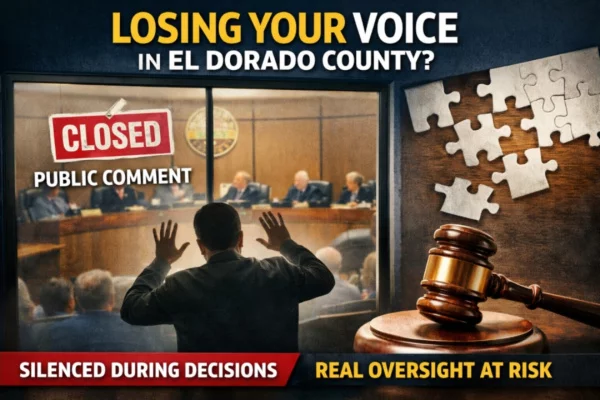
Restore the Public’s Right to Speak at El Dorado County Meetings

 Maxine K. signed
just now
Adam B. signed
just now
Maxine K. signed
just now
Adam B. signed
just now
Petition to the El Dorado County Board of Supervisors
We, the undersigned residents and taxpayers of El Dorado County, respectfully demand that the Board of Supervisors rescind its recently adopted public comment policy governing non-hearing agenda items —which consolidates public comment on all agenda items into a single three-minute period held before any items are heard — and immediately restore meaningful, item-by-item public participation at Board meetings.
Why This Matters
Public comment is not a courtesy.
It is a right — and a critical safeguard in local government.
Under the newly adopted policy, members of the public are often required to speak before staff presentations and before the Board begins deliberating. Once the actual discussion starts, the public is barred from responding — even when new information is revealed or errors become apparent.
The result is that residents may watch decisions being made, but cannot participate when it matters most.
That is not meaningful public engagement. It turns the public into bystanders.
Transparency protects taxpayers.
Public participation protects accountability.
The Law Is Clear
California’s Brown Act guarantees the public the right to address a legislative body on any item of interest to the public, before or during the body’s consideration of that item.
A policy that requires the public to speak without access to relevant information — and then prohibits them from speaking once deliberation begins — undermines that right and the purpose of open government.
Our Demand
We respectfully call on the El Dorado County Board of Supervisors to:
- Immediately rescind the consolidated public comment policy adopted under Agenda Item 25-2034;
- Restore item-by-item public comment on non-hearing agenda items; and
- Affirm that transparency and public participation are core values of County governance, not obstacles to be managed.
This is about whether the people of El Dorado County have a real seat at the table — or are reduced to watching decisions after the fact.
We urge the Board to choose openness, accountability, and trust.
 Share on Facebook

Enter your details on the next page
Comment
See More 0