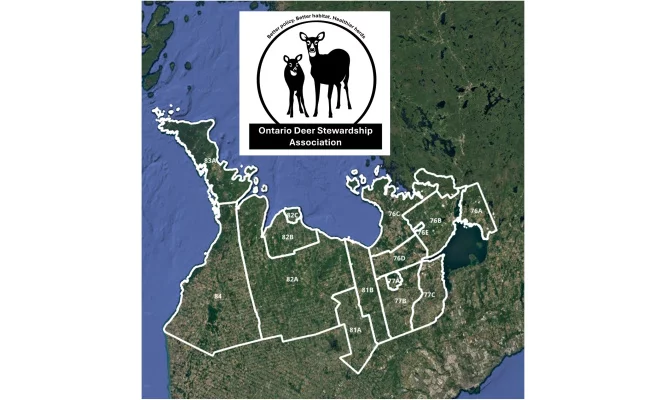
Petition to Restore White-Tailed Deer Populations in Ontario’s Midwestern Snowbelt WMUs
 Maxine K. signed
just now
Adam B. signed
just now
Maxine K. signed
just now
Adam B. signed
just now
***IMPORTANT - PLEASE READ***
DO NOT DONATE. Donations do not go to the Ontario Deer Stewardship Association (ODSA) and ODSA is not asking for any money or donations. Donations are being solicited through the ipetition platform, not the ODSA.
Restoring Sustainable Whitetail Herds in Ontario's Midwestern Snowbelt
We, the undersigned, respectfully petition the Ontario Ministry of Natural Resources (OMNR) and the Ontario Big Game Management Advisory Committee (BGMAC) to address the sustained scarcity of white-tailed deer in Ontario’s midwestern snowbelt Wildlife Management Units, which include WMUs: 84; 83A; 82A,B; 81A, B; 77A,B,C,D,E, and 76A B, C.
A healthy and balanced deer population provides substantial recreational, ecological, and economic value. Current deer densities in these WMUs are insufficient to meet hunting demand and have diminished broader recreational enjoyment across the region.
Background and Evidence
The Ontario Deer Stewardship Association (ODSA), a grassroots organization of hunters, farmers, landowners, and wildlife enthusiasts, has evaluated all Ontario WMUs actively managed for deer. ODSA’s analyses indicate that more than 75% of Ontario WMUs fall below reasonable population thresholds.
The midwestern snowbelt units in particular have experienced substantial and prolonged declines. Independent indices—including Ministry of Transportation wildlife–vehicle collision (WVC) data and OMNR hunter harvest success rates—consistently indicate chronically low deer abundance, in some cases continuing to worsen.
Importantly, ODSA’s analyses show that winter severity alone does not explain these declines. Observed reductions in deer abundance exceed winter-based expectations by more than fivefold. Historical data demonstrate that higher deer densities were sustained in the late 1990s and early 2000s under comparable or more severe winter conditions.
These findings suggest a broader regime shift in herd survival and/or reproduction, the precise causes of which remain uncertain.
Alignment with Provincial Policy
Under Ontario’s Cervid Ecological Framework (CEF), CEZ E3 (which includes midwestern Ontario) is to be managed to:
“Maintain moderate to high density populations within socially acceptable limits and ecological carrying capacity (e.g., winter habitat where appropriate) through [the] provincial deer management program.”
Per the CEF, Moderate-to-High density classes correspond to approximately 14–30 deer per km² of cover habitat.
In contrast to the CEF policy, large areas of suitable habitat within the midwestern snowbelt are scarcely occupied by deer. In contrast, neighbouring southern WMUs (e.g., 85A and 85B) maintain higher deer densities and recreational opportunity while balancing agricultural and road safety considerations. These neighbouring units experience comparable winter conditions, demonstrating that higher sustainable densities are achievable within the broader region.
Our objective is for the listed snowbelt WMUs to support deer populations comparable to neighbouring southern units and consistent with CEF targets.
Requested Management Actions
Recognizing that stakeholders may differ in preferred approaches, we respectfully propose the following management options for endorsement by signatories:
1. Adjust Antlerless Deer Tag Allocations
For WMUs 84, 83A, 82, 81, 77, and 76:
- Set antlerless quotas to achieve no more than a 33% draw success rate based on 2025 applicant numbers.
- Units currently below 33% should remain unchanged; units above 33% should be reduced accordingly.
Maintain reduced quotas until:
- Antlered harvest success ≥ 25% (antlered kill ÷ active hunters ≥ 0.25)
- All-sex harvest density ≥ 3 deer per km² of cover habitat.
A sustained harvest density of ≥3 deer/km² of cover corresponds to an approximately 10–20% annual removal rate under CEZ density targets and would indicate meaningful herd recovery.
This approach preserves season structure and hunter participation while protecting future population growth.
2. Suspend Supplemental Deer Tags Until Recovery Benchmarks Are Met
Cease issuance of Supplemental Deer Tags within the listed WMUs until:
- Deer harvest reaches ≥3 deer/km² of cover habitat.
- This threshold is sustained for at least two consecutive years.
3. Reinstate a Reliable Single-Use Tagging System
The current printable tagging system permits unlimited reprinting of paper tags, creating enforcement challenges and enabling poachers. Illegal activities that were historically straightforward to detect under the sticker tagging system are now more difficult to confirm.
We request a return to a secure single-use tagging system that strengthens anti-poaching enforcement and supports conservation objectives.
Conclusion
As hunters, landowners, farmers, rural residents, and wildlife enthusiasts, we share the common goal of restoring a sustainable, moderate-to-high density deer population in Ontario’s midwestern snowbelt WMUs.
Signatories may endorse one or more of the proposed actions (indicate specific endorsements in the Petition Comments Section). This petition seeks to present a unified and constructive voice emphasizing:
- The urgency of addressing chronic low deer densities.
- Alignment with Ontario’s Cervid Ecological Framework.
- Clear recovery benchmarks.
- Practical, measurable management tools.
We respectfully request that the OMNR and BGMAC take timely action to restore deer populations in these WMUs to levels consistent with provincial objectives and public expectations.
Thank you for your consideration.
Sincerely,
Daniel Andres
Petition Organizer, founder of Ontario Deer Stewardship Association
 Share on Facebook
Comment
See More 0