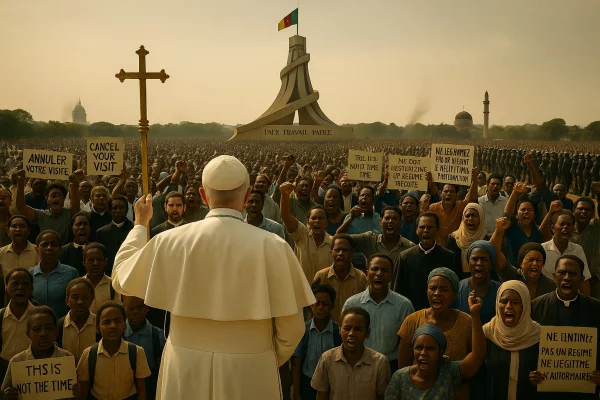
POPE LEO XIV: CANCEL YOUR PLANNED VISIT TO CAMEROON

 Maxine K. signed
just now
Adam B. signed
just now
Maxine K. signed
just now
Adam B. signed
just now
PETITION TO POPE LEO XIV: CANCEL YOUR PLANNED VISIT TO CAMEROONA Call for Prophetic Action Over Political Legitimization EXECUTIVE SUMMARY
We, the undersigned, respectfully but urgently call upon His Holiness Pope Leo XIV to cancel his planned visit to Cameroon. This visit, while pastoral in intent, will inevitably serve to legitimize an illegitimate, authoritarian regime that has:
- Stolen the October 12, 2025 presidential election through widespread fraud [1]
- Killed at least 55 protesters demanding electoral justice [2,3]
- Arrested at least 2,000 people, including over 800 in Douala alone [4,5]
- Perpetrated ongoing atrocities in the Anglophone regions for nearly a decade [6,7]
- Manufactured poverty through systematic corruption and misgovernance [8,9]
- Rejected meaningful dialogue to resolve multiple humanitarian crises [10,11]
A papal visit at this critical juncture would contradict Your Holiness’s own apostolic exhortation “Dilexit” and the Church’s preferential option for the poor, while emboldening a dictator who has spent 43 years oppressing the Cameroonian people [1,12].
I. THE STOLEN ELECTION: A CRISIS OF DEMOCRATIC LEGITIMACYThe Official Narrative vs. Reality
On October 27, 2025, Cameroon’s Constitutional Council declared Paul Biya, age 92, the winner of the October 12 presidential election with 53.66% of the vote [1]. This announcement triggered immediate nationwide protests and a violent government crackdown that has killed at least 55 people and resulted in the arrest of at least 2,000 protesters [2,3,4,5].
Evidence of Electoral Fraud
1. Disputed Results - Official results: Biya 53.66%, Opposition candidate Issa Tchiroma Bakary 35.19% [1] - Opposition tallies: Tchiroma won approximately 60% of the vote [1,13] - International observers and civil society groups corroborate opposition claims of manipulation [14]
2. Impossible Victory Margins in Conflict Zones The regime claims Biya won overwhelming majorities in regions where he is deeply unpopular [15]: - North West Region (Anglophone): 86.31% - in an area where separatists have fought government forces for 8 years [15] - South West Region (Anglophone): 68.79% - despite ongoing military occupation and atrocities [15] - Far North Region: 45.93% - despite a decade-long Boko Haram insurgency [15]
These figures defy credibility. In regions where the government has killed thousands of civilians and displaced hundreds of thousands, voting turnout and overwhelming support for the incumbent are statistically implausible [15].
3. Pre-Election Manipulation - Maurice Kamto, the leading opposition candidate who challenged Biya in 2018, was barred from running by electoral authorities [1] - The campaign period was limited to just 15 days - insufficient for meaningful democratic discourse [14] - Opposition leaders faced harassment, intimidation, and arrest [2,12]
4. Post-Election Violence and Mass Arrests Since the announcement of results, Cameroon’s security forces have engaged in systematic repression [2,3,4,5]:
Deaths: - At least 55 protesters killed by security forces according to opposition sources who spoke to Human Rights Watch [2,3] - International media citing UN sources reported 48 deaths [2,3] - Government communication minister acknowledged “several dozen” deaths but investigations remain ongoing [3]
Brutal Killings Documented: Human Rights Watch documented specific cases of lethal force [2,3]: - A 35-year-old trader shot in the genitals in Douala’s New Bell neighborhood on October 28 - he died the following day - A 34-year-old medical student killed by police gunfire in Douala on October 27 - A 44-year-old plumber shot in the stomach while police dispersed protesters with live ammunition - Many victims shot with live ammunition, not rubber bullets or tear gas
Mass Arrests: - At least 2,000 people detained according to pro-opposition lawyers assisting those arrested [4,5] - Over 800 arrested in Douala alone according to government minister Paul Atanga Nji [4] - 312 people named on lists compiled by lawyers, with 154 yet to be presented before a judge [2,3] - At least 6 detainees held at State Defense Secretariat, a facility where Human Rights Watch has documented routine torture [2,3]
Charges Carrying Death Penalty: Those arrested face charges including [2,3]: - “Hostility against the homeland” - “Revolution” - “Rebellion” - “Insurrection”
These offenses are punishable by death and have been applied indiscriminately [2,3]. Lawyers report severely limited access to clients and mistreatment upon arrest [2,3].
Human Rights Watch stated: “The violent crackdown on protesters and ordinary citizens across Cameroon lays bare a deepening pattern of repression that casts a dark cloud over the election” [2,3].
The International Crisis Group warned: “As government and opposition proclaim starkly different election outcomes, the prospects for Cameroon are alarming. Intensifying protests and an ever more violent state response pose immediate dangers” [16].
II. THE ANGLOPHONE CRISIS: EIGHT YEARS OF ATROCITIESSince 2016, the Cameroonian government has waged a brutal campaign of repression in the North West and South West regions (formerly British Southern Cameroons). What began as peaceful protests by lawyers and teachers demanding linguistic rights has become a full-scale humanitarian disaster [6,17].
Deaths: - Over 6,000-6,500 civilians killed by government forces and separatists (actual numbers believed to be much higher) [6,7,18,37] - Nearly 7,000 total deaths when including combatants [6]
Displacement - Anglophone Crisis Alone: - Over 900,000 internally displaced persons within Cameroon’s Anglophone regions [37,38] - 84,000 Cameroonian refugees in Nigeria [21] - Total Anglophone displacement: Over 1 million people [37,39]
Total Displacement - All Conflicts Combined: Cameroon faces multiple overlapping displacement crises [40,41,42]: - Anglophone Crisis (NW/SW regions): 1.1 million+ displaced - Boko Haram Insurgency (Far North): 300,000+ displaced [40,41] - CAR Spillover Violence (East Region): 45,000-60,000 displaced [42] - Total IDPs across all crises: Over 1.1 million Cameroonians [40] - Plus hosting: 350,000+ CAR refugees and other regional refugees
Humanitarian Need: - 3.3 million people affected by the Anglophone crisis, including 88,000 pregnant women and 800,000 women of reproductive age [37,43] - 3.3 million people nationwide need humanitarian aid in 2025 [19,37]
Education Crisis: - 2,066 schools non-operational (41% of all schools in the regions) [19] - 488,656 children affected by school closures [19] - 700,000+ children forced out of school since 2017 [23] - Armed separatists have violently enforced education boycotts; both sides use schools as weapons [6]
Food Insecurity: - 2.5 million people face acute food insecurity in crisis-affected regions [19]
Violence Escalation: - 7,035 security incidents reported in 2024 (nearly double the 4,519 incidents in 2023) [19] - 2,098 incidents in first trimester of 2025 alone - a 19% increase over same period in 2024 [19]
The Cameroonian government has systematically committed human rights violations [6,7]: - Extrajudicial killings of civilians - Arbitrary arrests and detentions (described by Cameroonian bishops as “kidnappings”) [16] - Torture of detainees - documented at State Defense Secretariat [2,3] - Sexual and gender-based violence against women and girls - Burning of villages and civilian infrastructure - Denial of humanitarian access to affected populations
The Church’s Rejected Mediation
In 2017, Catholic bishops from the Anglophone regions produced a detailed document outlining solutions to the crisis and requested a meeting with President Biya to offer mediation. President Biya never received them [10,11].
Archbishop Andrew Nkea, President of the National Episcopal Conference, has repeatedly called for direct talks between the government and separatists. He told government officials in March 2025: “The boys [separatist fighters] feel you are merely talking among yourselves or to your friends… All wars, including the First and Second World Wars, ended at the negotiating table” [24].
This rejection of Church mediation reveals the regime’s unwillingness to engage in genuine dialogue - even with the institution Your Holiness now represents.
International Recognition
- The UN Security Council has held only one meeting on Cameroon (2019) [7]
- The European Commission describes this as requiring “urgent humanitarian intervention” [19]
- Cameroon is now the world’s most neglected displacement crisis according to humanitarian agencies [22]
In the Far North region, civilians face a separate but equally devastating crisis [7,19,40,41]:
Impact of Islamist Insurgency (Boko Haram and ISWAP): - Over 3,000 Cameroonians killed since insurgency began [18] - Over 300,000 people displaced in the Far North region [40,41] - 720 incidents and 780 fatalities in 2024 alone - a threefold increase in incidents [7] - 1,367 human rights violations documented in first quarter of 2025 [7] - Widespread abductions for ransom, particularly targeting men and boys [7] - Suicide bombings, village raids, and attacks on civilians, schools, and religious institutions [40,41]
Humanitarian Response: The Cameroon Crisis Response Plan 2025-2026 targets 160,000 people in the Far North for humanitarian assistance, but access remains severely limited due to ongoing violence [40,41].
The regime’s military-only approach has failed to protect civilians or address root causes of extremism.
IV. CAR SPILLOVER VIOLENCE: A THIRD HUMANITARIAN CRISISIn Cameroon’s East Region, the population suffers from spillover violence from the Central African Republic’s ongoing civil war [42]:
Impact of CAR Conflict: - 45,000-60,000 Cameroonians displaced in the East Region due to cross-border raids and insecurity [42] - Over 350,000 CAR refugees hosted in Cameroon, straining local resources and contributing to secondary displacement of Cameroonian communities [42] - Armed incursions by ex-Séléka and Anti-balaka militias from CAR [42] - Banditry and insecurity along the porous CAR-Cameroon border [42] - Limited humanitarian access due to ongoing violence and poor infrastructure [42]
Cameroon: A Nation Under Multiple Sieges
Total Crisis Overview [40,41,42]: Cameroon simultaneously faces: 1. Anglophone Crisis: 1.1 million+ displaced 2. Boko Haram Insurgency: 300,000+ displaced 3. CAR Spillover Violence: 45,000-60,000 displaced 4. Intercommunal Clashes: Additional displacement from herder-farmer conflicts 5. Climate Shocks: Floods and droughts displacing thousands annually
The Biya regime has failed to address any of these crises effectively, choosing military force over dialogue, repression over reconciliation, and self-enrichment over service to the people.
V. SYSTEMATIC CORRUPTION AND MANUFACTURED POVERTYTransparency International Corruption Perceptions Index 2024 [8]: - Cameroon score: 26 out of 100 (where 100 = very clean) - Global ranking: 140th out of 180 countries - Score declined from 27 in 2023 - worsening corruption
This places Cameroon among the most corrupt nations in the world.
Despite being rich in natural resources (oil, cocoa, minerals), Cameroon suffers from pervasive poverty [9,15]: - 40% of Cameroonians live below the poverty line [9] - Urban unemployment: 35% [9] - The average Cameroonian is no wealthier than in 1986 - zero economic progress in nearly 40 years [9] - 51% of young Cameroonians have considered emigrating (2024 Afrobarometer) [9]
Where Does the Money Go?
President Biya and his inner circle have enriched themselves while impoverishing the nation [2,25]: - Biya spends extended periods in Europe, particularly at luxury hotels in Geneva and Switzerland [2,15] - He is rarely seen in Cameroon and has been described as “the absent landlord” [9] - His regime is characterized by neopatrimonialism - personal rule where state resources are treated as the ruler’s private property [25] - Close associates are allowed to embezzle with impunity, then used against them if they become political threats [25]
The Cameroonian Catholic Church itself has condemned “a pattern of ethnic exclusion and misappropriation of resources” [16].
VI. THE ILLEGITIMATE CONSOLIDATION OF POWERPaul Biya has ruled Cameroon since 1982 - longer than most citizens have been alive (70% of the population is under 35) [2].
Key Milestones in Democratic Erosion [1,2]: - 1982: Assumed presidency - 2008: Constitutional amendment abolished term limits, allowing unlimited rule - 2018: Won disputed election amid widespread fraud allegations - 2024: Disappeared from public view for 51 days, triggering death rumors [16] - 2025: At age 92, “won” eighth seven-year term, extending potential rule until 2032 (age 99)
Biya’s government is dominated by elderly officials who have no connection to Cameroon’s young population [9]: - President Paul Biya: 92 years old - Constitutional Court President Clement Atangana: 84 years old - Chief of Staff Claude Meka: 86 years old - Senate President Marcel Niat: 90 years old
The median age in Cameroon is 18 years old [15]. This represents a fundamental disconnect between rulers and ruled.
Paul Biya has ruled Cameroon since 1982 - longer than most citizens have been alive (70% of the population is under 35) [2].
Key Milestones in Democratic Erosion [1,2]: - 1982: Assumed presidency - 2008: Constitutional amendment abolished term limits, allowing unlimited rule - 2018: Won disputed election amid widespread fraud allegations - 2024: Disappeared from public view for 51 days, triggering death rumors [16] - 2025: At age 92, “won” eighth seven-year term, extending potential rule until 2032 (age 99)
Biya’s government is dominated by elderly officials who have no connection to Cameroon’s young population [9]: - President Paul Biya: 92 years old - Constitutional Court President Clement Atangana: 84 years old - Chief of Staff Claude Meka: 86 years old - Senate President Marcel Niat: 90 years old
The median age in Cameroon is 18 years old [15]. This represents a fundamental disconnect between rulers and ruled.
Absence of Democratic Institutions
- Opposition has virtually no representation in National Assembly or Senate [6]
- Legislature is dominated by Biya’s CPDM/RDPC party (164 of 180 deputies) [6]
- Judicial independence is non-existent - courts serve regime interests [14]
- Press freedom is severely restricted - at least 3 journalists killed in 2023 [6]
- Civil society space is closed - activists face arrest and harassment [6,16]
In your first apostolic exhortation “Dilexit” (“I Have Loved You”), Your Holiness emphasized the Church’s preferential option for the poor and explicitly criticized regimes that manufacture poverty through bad governance [10,11].
The Biya regime is the embodiment of what “Dilexit” condemns: - Systematic corruption that diverts resources from the poor [8] - Bad governance that has kept Cameroonians as poor in 2025 as they were in 1986 [9] - Violence against those who protest injustice [2,3] - Rejection of dialogue and reconciliation [10,11]
The Poor Who Cry OutThe young Cameroonians who took to the streets after the October 12 election - at least 55 of whom were killed by security forces [2,3] - are the poor Your Holiness speaks of in “Dilexit.”
They are poor because [9,16]: - They cannot find employment (35% urban unemployment) - They cannot access quality education (schools closed by conflict) - They face a regime that embezzles state resources - They have no voice in governance - They are killed when they demand justice
To visit Cameroon now is to shake hands with those who murdered these young people for demanding their rights.
Pope Francis’s Prophetic WitnessYour predecessor, Pope Francis, established a powerful precedent of speaking truth to power in Africa. In 2023, visiting the Democratic Republic of Congo, he declared [26]:
“Hands off the Democratic Republic of the Congo! Hands off Africa! Stop choking Africa: it is not a mine to be stripped or a terrain to be plundered. The poison of greed has smeared its diamonds with blood.”
Your Holiness, the same poison of greed has smeared Cameroon’s oil with blood. The same exploitation and corruption Pope Francis condemned in the DRC exists in Cameroon [8,25].
Will you maintain this prophetic witness, or will your visit be interpreted as blessing a regime that does exactly what Pope Francis condemned?
VIII. THE POLITICAL DIMENSIONS OF A PAPAL VISITHead of State Meets Head of State
While Your Holiness comes primarily as a spiritual leader, you are also the Head of State of Vatican City. A papal visit inherently has diplomatic and political dimensions.
Meeting President Biya will be interpreted as: - Recognition of his government’s legitimacy - Acceptance of the disputed election results - Endorsement of his continued rule - Validation of his methods of governance
Historical Precedent
When Pope John Paul II visited Cameroon in 1985 and 1995, the political context was different. While Biya’s regime was already authoritarian, it had not yet: - Abolished term limits - Ruled for 43 years - Presided over the Anglophone Crisis - Stolen multiple consecutive elections - Killed dozens of protesters demanding democracy in a single week
Context matters. A visit that might have been appropriate in 1985 or 1995 carries entirely different implications in 2025.
IX. ALTERNATIVES TO LEGITIMIZATIONWhat the Church Can Do Instead
We do not ask Your Holiness to abandon the Cameroonian people - far from it. We ask that you exercise prophetic solidarity rather than political legitimization.
Specific Alternatives:
- Issue a Public Statement calling for:
- Transparent review of election results by independent international observers
- Release of all political prisoners and detained protesters
- End to violence against peaceful demonstrators
- Meaningful dialogue on the Anglophone Crisis
- Concrete anti-corruption measures
- Send a Papal Envoy to:
- Meet with opposition leaders, civil society, and victims
- Assess the humanitarian situation independently
- Facilitate dialogue between government and opposition
- Report findings to the Holy See and international community
- Condition Any Future Visit on:
- Verifiable progress toward electoral justice
- Meaningful steps toward resolving the Anglophone Crisis
- Release of political prisoners
- Concrete anti-corruption reforms
- Demonstrated commitment to human rights
- Amplify Church Leadership in Cameroon by:
- Supporting Cameroonian bishops’ calls for dialogue and change
- Highlighting their rejected mediation efforts
- Empowering local Church to be prophetic voice
History shows that postponing or canceling controversial visits can be more prophetic than proceeding: - It signals that certain behaviors are unacceptable - It creates leverage for demanding reforms - It shows solidarity with the oppressed rather than the oppressor - It demonstrates that the Church will not be used for political legitimization
Your Holiness, saying “not yet” to Cameroon would be a powerful act of solidarity with the poor and oppressed - the very people “Dilexit” calls us to prioritize.
X. THE TESTIMONY OF CHURCH LEADERSCameroonian Bishops Call for Change
In the months leading up to the October 2025 election, multiple Cameroonian bishops courageously called for political change and condemned the Biya regime’s failures. Their prophetic voices must inform Your Holiness’s decision.
Archbishop Andrew Nkea of Bamenda (President, National Episcopal Conference)
Archbishop Nkea emphasized the urgent need for change in the 2025 “jubilee year,” calling on citizens to advocate for transformation in the upcoming elections [27]. Many interpreted his remarks as the Church’s official stance against President Biya’s candidacy, echoing sentiments previously expressed by other bishops [27].
On dialogue with separatists, Archbishop Nkea told government officials: “The boys [separatist fighters] feel you are merely talking among yourselves or to your friends… All wars, including the First and Second World Wars, ended at the negotiating table. The Ambazonians are ready for meaningful dialogue, and we, as religious leaders, can facilitate it” [24].
Cardinal Christian Wiyghan Tumi (1930-2021): Cameroon’s Fearless Preacher
The late Cardinal Christian Tumi, Cameroon’s first and only cardinal, was known as a “fearless preacher” who spoke truth to power until his death on Good Friday, April 2, 2021, at age 90 [44,45]. His successor, Archbishop Samuel Kleda of Douala, announced his passing with “profound sadness and deep sorrow” [46].
Cardinal Tumi was a strong critic of the Biya regime, often calling out the government over allegations of [44,45]: - Corruption and electoral malpractices - Entrenchment of a gerontocracy in Cameroon - Lack of respect for democracy and human dignity
“If I were Biya, I would resign,” Cardinal Tumi said on several occasions, much to the displeasure of Biya’s supporters [44]. Even at age 90, he remained active in promoting peace and reconciliation, leading a “peace caravan” to the Anglophone regions in 2019 [44].
Pope Francis praised Cardinal Tumi for leaving “an unforgettable mark on the Church and on the social and political life” of Cameroon, noting that he “always committed himself courageously to the defense of democracy and the promotion of human rights” [45,46].
Archbishop Samuel Kleda of Douala: The Living Voice of Prophetic Critique
Archbishop Samuel Kleda, successor to Cardinal Tumi as Archbishop of Douala, has emerged as one of the most vocal and fearless critics of the Biya regime in the lead-up to the 2025 elections. His prophetic voice continues the legacy of Cardinal Tumi.
“Democracy in Cameroon exists only in name. In reality, it does not exist.” - Archbishop Kleda, December 2024 [47]
On Biya’s 2025 Candidacy: In a December 2024 RFI interview, Archbishop Kleda was unequivocal: “I would simply say that this is not realistic, simply that this is not realistic” when asked about Biya seeking an eighth term at age 92 [48,49].
He emphasized: “I believe that as human beings, our time in this world is finite. We are not capable of performing miracles, which is why I emphasize the importance of transition. It is crucial to ensure everything is well-prepared and to avoid being caught off guard” [48].
August 2025 Pastoral Letter - A Scathing Indictment: Just two months before the October election, Archbishop Kleda released a devastating 16-page pastoral letter condemning the Biya regime [50,51,52,53]:
On National Conditions: - “Our society is shaken by multiple ills that afflict all social strata” - Condemned “anti-gospel acts” deeply rooted in the country’s governance - Described “a society marked by corruption, a perverted democracy, endemic poverty and unemployment”
On Resource Exploitation: Archbishop Kleda found it unacceptable that hydrocarbons are “not serving the national economy, but are the preserve of a small circle of political power that awards itself contracts and positions and arrogates all rights and privileges to itself, while the majority languishes in poverty” [50].
He also decried injustice and exploitation in Cameroon’s mining sector [54], noting that the nation’s vast natural resources are being plundered while citizens starve.
On Corrupted Democracy: - “A democracy where political actors are despised, brutalized, and imprisoned is doomed to failure” [50,51] - Denounced a political system marked by “institutional violence, intimidation, and lies” [51] - Warned that electoral results are often a foregone conclusion, undermining the democratic principle of genuine choice” [47]
On the Anglophone Crisis: Archbishop Kleda condemned both separatist fighters for killings and kidnappings, and “the brutality of the army, which razes entire villages on the mere suspicion of support (for the enemy)” [50].
On Youth Exodus: He described a “brain drain” where thousands of young people risk their lives leaving Cameroon in search of better opportunities abroad, “depriving Cameroon of its young talents, scientists, engineers, and health professionals” - a phenomenon that “seriously compromises the nation’s future” [51].
Post-Election Violence Response (November 2025): After the violent crackdown on protesters, Archbishop Kleda issued a powerful reminder: “Democracy does not coexist with cannon fire, threats, or arbitrary arrests. One does not organize elections to kill citizens. You cannot govern a people with weapons” [55].
His Call to Voters: Despite the dire situation, Archbishop Kleda called on Cameroonians to “choose a president of the Republic” as “a civic duty that falls to each and every one of us, and which will shape the future of our country” [50].
He urged: “Our civic action must lay the foundations for a new and prosperous society, based on peace and justice, and focused on the well-being of us all” [50].
Government Response: The regime’s allies attacked Archbishop Kleda for his prophetic witness. Professor Owona Nguini, a close Biya ally, accused him of “using the pulpit for partisan politics” and claimed “the bishop stepped away from his priestly mission to engage in partisan politics” [50,51].
The U.S. Embassy Assessment: Ashley White, director of the U.S. embassy’s Douala branch, told the National Catholic Reporter that the Catholic Church “is one of the only neutral actors in Cameroon” and compared Archbishop Kleda’s role to that of then-Archbishop Jorge Bergoglio (now Pope Francis) in Buenos Aires, who was referred to as “a leader of the opposition” [56].
Bishop Emmanuel Abbo of Ngaoundere: “Even the Devil Would Do Better”
In January 2025, Bishop Abbo delivered one of the most striking prophetic statements by any Cameroonian cleric. He declared [29,30]:
“What have Cameroonians not suffered? Cameroonians have suffered so much that even the devil can’t inflict greater pain on the people of this country.”
“It would even be better if the devil took over the management of affairs in Cameroon.”
Bishop Abbo explained that the Biya regime has inflicted such suffering that: - Young people attend school without hope of ever getting jobs - Youth resort to drug abuse out of desperation - Poverty deepens while the rich-poor gap widens - Political leaders stash money in their homes while ordinary Cameroonians cannot provide for basic needs - “The most terrible suffering is that Cameroonians are forbidden to express their suffering” [29,30]
He referenced threats by Minister Paul Atanga Nji who describes the state as “a blender” that will crush anyone voicing contrary opinions [29,30]. Bishop Abbo asked: “How can we promise death to those who only ask for a minimum to survive?” [29,30]
Bishop Barthélémy Yaouda Hourgo of Yagoua
Bishop Yaouda Hourgo stated that the people had reached the limits of their suffering to the extent that even the devil cannot inflict greater pain [30]. This echoed Bishop Abbo’s assessment of the regime’s brutality.
Bishop Paul Lontsié-Keuné of Bafoussam: “Ready to Die for Truth”
Bishop Lontsié-Keuné, known as “a lightning rod for pro-democratic forces,” put the government on red alert ahead of the October election, declaring [31]:
“So if there is only one person to be killed, let them kill me and leave you, the people of God alone. And if there is only one person to be imprisoned, let them imprison me and leave you alone.”
He blasted authorities for continued intimidation of citizens and voiced deep concerns about Cameroon’s political process itself [31]. His courage inspired his priests to speak out against injustice.
Father Philype Kahake of Saint Robert Parish stated: “Human life no longer has any value; it is cheap, trampled underfoot… To those who govern us, we say: thou shalt not kill. It is not the people who have the weapons; it is those who govern us who have the weapons” [31].
Bishop Emmanuel Dassi of Bafia
Bishop Dassi expressed hope that the 2025 elections would be “good elections with good candidates,” noting that the bishops had cited the country’s many problems including the high cost of living, the raging separatist crisis, and the Boko Haram crisis as “some of the most visible failures of the Biya government” [32].
Canon Lawyer Nchumbonga George Lekelefac’s Appeal
Canon lawyer Lekelefac issued an open letter urging Cameroon’s bishops to follow the example of their counterparts in the Democratic Republic of Congo, where “outspoken criticism of President Joseph Kabila’s extended rule led to significant political reform” [30].
He wrote: “Cameroon is in distress. The prolonged rule of President Biya has led to economic stagnation, political repression, human rights abuses, and the unresolved Anglophone Crisis, which has claimed countless lives and displaced millions… Cameroon, blessed with abundant resources, sees over half its population in poverty, its infrastructure crumbling, and its democratic institutions hollowed out” [30].
Father Ludovic Lado’s Open Letter
Father Ludovic Lado, SJ, wrote directly to Your Holiness opposing the visit [10,11]. His arguments include:
“We are dealing with an illegitimate regime cloaked in legality. The Holy Father’s visit would be a form of political whitewashing, a sort of legitimization of this illegitimate, repressive, and violent power.”
Father Lado emphasized that this is not politicizing religion but rather prophetic action - calling the regime to account for manufacturing poverty and violence through bad governance, exactly what Your Holiness condemned in “Dilexit” [10,11].
The Church’s Moral Authority at Stake
These bishops and priests have risked their safety and freedom to speak truth to power. They have: - Documented the regime’s failures - Called for political change - Attempted to mediate conflicts (and been rejected) - Witnessed firsthand the suffering of their people - Compared Biya’s governance to that of the devil himself
Will Your Holiness honor their prophetic witness, or undermine it by legitimizing the regime they have so courageously condemned?
XI. THE MORAL IMPERATIVEYour Holiness must consider:
1. Will this visit help or harm the poor? - Harm: It legitimizes their oppressor and prolongs their suffering - Harm: It signals that stolen elections have no consequences - Harm: It tells the 55+ protesters who died demanding justice that their sacrifice meant nothing
2. Will this visit advance peace or enable injustice? - Enable injustice: It rewards a regime that rejected Church mediation - Enable injustice: It ignores 8 years of atrocities in the Anglophone regions - Enable injustice: It accepts violence as the means to resolve political disputes
3. Will this visit reflect the Gospel or political expediency? - The Gospel calls us to stand with the oppressed: the protesters killed, the 2,000+ arrested, the displaced, the impoverished - Political expediency suggests maintaining diplomatic relations regardless of moral cost
The Witness of the Universal Church
The global Catholic Church is watching. What message does this visit send?
- To dictators worldwide: You can steal elections, kill 55+ protesters, arrest 2,000+ people - and still receive papal legitimization
- To the faithful suffering under oppression: The Church prioritizes diplomatic protocol over prophetic solidarity
- To young people: The Church’s option for the poor is rhetoric, not reality
These are not the messages Your Holiness wishes to send. We know this because of “Dilexit.”
XII. CONCLUSION: A PLEA FOR PROPHETIC LEADERSHIPYour Holiness, we write with profound respect for your office and deep hope in your leadership. We believe you can and will choose the prophetic path over political convenience.
Visit now = Legitimize an illegitimate regime, betray the poor, contradict “Dilexit,” undermine courageous Cameroonian bishops
Cancel or postpone = Exercise prophetic solidarity, defend the oppressed, embody the Gospel, honor Church leaders who spoke truth to power
We pray that Your Holiness will: - Listen to the cry of the poor in Cameroon - Remember the 55+ protesters killed for demanding justice - Stand with the 2,000+ arrested for exercising their rights - Honor the bishops who compared Biya’s rule to the devil - Demand accountability for stolen elections and human rights abuses - Embody the Church’s preferential option for the poor through actions, not just words
The Prophet’s Call
In the tradition of Nathan confronting David, Amos denouncing injustice, and Christ overturning the tables in the temple, we ask Your Holiness to be a prophet in this moment.
Say to the Biya regime: “Not yet. Not until you demonstrate genuine commitment to justice, democracy, and the welfare of your people.”
Say to the Cameroonian people: “The Church sees your suffering. The Church stands with you. The Church will not legitimize those who oppress you.”
Say to the martyred protesters: “Your sacrifice was not in vain. The Church remembers you.”
Say to the courageous bishops: “I hear your prophetic voice. I stand with you.”
PETITION STATEMENTWE, THE UNDERSIGNED, call upon Pope Leo XIV to:
- CANCEL or POSTPONE the planned visit to Cameroon
- ISSUE A PUBLIC STATEMENT demanding:
- Transparent review of October 12, 2025 election results
- End to violence against peaceful protesters
- Immediate release of 2,000+ political prisoners
- Independent investigation into the killing of 55+ protesters
- Meaningful dialogue to resolve the Anglophone Crisis
- Concrete anti-corruption reforms
- SEND A PAPAL ENVOY to independently assess the situation and facilitate dialogue
- CONDITION ANY FUTURE VISIT on verifiable progress toward justice and reconciliation
- AMPLIFY AND SUPPORT Cameroonian Church leaders’ prophetic witness
SUPPORTING ORGANIZATIONS & INSTITUTIONS
Organizations, churches, civil society groups, institutions, etc. who endorse petition.
SIGNATORIESGoal: 10,000 Signatures
SOURCESPrimary Sources on Election Violence and Mass Arrests
[1] 2025 Cameroonian Presidential Election. (2025, November). Retrieved from multiple international news sources.
[2] Human Rights Watch. (2025, November 12). Cameroon: Killings, Mass Arrests Follow Disputed Elections. https://www.hrw.org/news/2025/11/12/cameroon-killi...
[3] JURIST News. (2025, November 12). HRW raises alarm over Cameroon use of lethal force following disputed elections. https://www.jurist.org/news/2025/11/rights-group-r...
[4] Mimi Mefo Info (MMI News). (2025). Paul Atanga Nji livre le bilan de la crise post-électorale à Douala.
[5] Legal News Feed. (2025, November). Cameroon’s Post-Election Turmoil: Surge in Violence and Arrests Draws Global Condemnation.
Sources on Human Rights Violations and Anglophone Crisis
[6] Human Rights Watch. (2024, January 11). World Report 2024: Cameroon. https://www.hrw.org/world-report/2024/country-chap...
[7] Global Centre for the Responsibility to Protect. (2025, July 15). Cameroon. https://www.globalr2p.org/countries/cameroon/
Sources on Corruption and Economic Conditions
[8] Transparency International. (2024). 2024 Corruption Perceptions Index - Explore Cameroon’s results. https://www.transparency.org/en/cpi/2024/index/cmr
[9] The Conversation. (2025, October). Paul Biya at 92: Life presidency in Cameroon enters a fragile final phase. https://theconversation.com/paul-biyas-life-presid...
Sources on Church Leaders’ Testimony
[10] Lebledparle. (2025). Translation: Priest’s Open Letter Opposing Papal Visit to Cameroon [Interview with Father Ludovic Lado].
[11] Lebledparle. (2025). Additional reporting on Fr. Lado’s letter and Church concerns about legitimizing Biya regime.
[12] Al Jazeera. (2025, October 27). Biya declared victor of Cameroon election: Why deadly protests broke out. https://www.aljazeera.com/news/2025/10/27/biya-dec...
Sources on Opposition and Election Fraud
[13] The Africa Report. (2025, October). Cameroon elections: Tchiroma Bakary rejects Biya’s prime minister offer. https://www.theafricareport.com/395780/cameroon-el...
[14] Journal of Democracy. (2025, November). Cameroon’s election casts a long shadow. https://www.journalofdemocracy.org/online-exclusiv...
[15] Chatham House. (2025, October). Suppression of post-election protests in Cameroon will not solve the country’s looming succession crisis. https://www.chathamhouse.org/2025/10/suppression-p...
[16] International Crisis Group. (2025, October). Defusing Cameroon’s dangerous electoral standoff. https://www.crisisgroup.org/africa/cameroon/defusi...
Sources on Humanitarian Situation
[17] USCRI. (2025, March 28). Timeline: Cameroon & the “Anglophone Crisis”. https://refugees.org/timeline-cameroon-the-angloph...
[18] International Crisis Group. (2025). Cameroon country page. https://www.crisisgroup.org/africa/central-africa/...
[19] European Commission - Civil Protection and Humanitarian Aid Operations. (2025). Cameroon. https://civil-protection-humanitarian-aid.ec.europ...
[21] THISDAYLIVE. (2022, June 21). Nigeria Has 3.2 Million IDPs, 84,000 Refugees, UNHCR Reveals.
[22] African Elements. (2025, June 4). Cameroon’s dire neglected displacement crisis unveiled.
[23] The Conversation. (2025, August 19). Cameroon’s conflict is part of a bigger trend: negotiations are losing ground to military solutions. https://theconversation.com/cameroons-conflict-is-...
Sources on Church Leadership and Calls for Change
[24] Crux Now. (2025, March 20). Archbishop urges direct talks with separatist fighters in Cameroon. https://cruxnow.com/church-in-africa/2025/03/archb...
[25] Corruption in Cameroon. (2025, June 19). Comprehensive analysis of corruption patterns.
[26] Crux Now. (2025, May 3). Cameroonian bishop reflects on the legacy of Pope Francis for Africa. https://cruxnow.com/church-in-africa/2025/05/camer...
[27] Lebledparle. (2025, January 9). Bishop Andrew NKEA of Bamenda calls for change in Cameroon ahead of 2025.
[29] Crux Now. (2025, January 11). Cameroon Bishops tell President Biya to not seek another term. https://cruxnow.com/church-in-africa/2025/01/camer...
[30] Crux Now. (2025, July 19). Canon lawyer urges Cameroon bishops to oppose President Biya running again. https://cruxnow.com/church-in-africa/2025/07/canon...
[31] Crux Now. (2025, August 27). Cameroon Bishop puts government on red alert ahead of election. https://cruxnow.com/church-in-africa/2025/08/camer...
[32] Crux Now. (2025, January 10). Bishop in Cameroon wants nation to celebrate ‘good elections’ in a jubilee year.
Sources on Cardinal Tumi and Archbishop Kleda
[37] UNFPA Cameroon. (2025, February). Situation Report #29.
[38] UNHCR. (2025, October). Cameroon Country Data.
[39] Global Voices. (2025). The Silent Crisis of Cameroon’s Ransom-Fueled War.
[40] RFI. (2025). Cameroon’s Forgotten Crisis Displaces Nearly a Million People.
[41] IOM Cameroon & UNICEF. (2025, September). Cameroon Crisis Response Plan 2025-2026 & Humanitarian Situation Report.
[42] Multiple Sources. (2025). CAR Spillover Violence in Cameroon East Region.
[43] UNICEF Cameroon. (2025, September). Humanitarian SitRep.
[44] Crux Now. (2021, April 5). Cameroon’s lone cardinal and ‘fearless preacher’ dies on Good Friday. https://cruxnow.com/church-in-africa/2021/04/camer...
[45] Vatican News. (2021, April 4). Pope sends condolences for death of Cardinal Christian Tumi. https://www.vaticannews.va/en/pope/news/2021-04/po...
[46] CISA News Africa. (2021, April 5). CAMEROON: Church Mourns Archbishop Emeritus Christian Cardinal Tumi.
[47] PAN AFRICAN VISIONS. (2024, December 5). “Cameroon’s Democracy Exists Only in Name” – Says Archbishop Kleda.
[48] CameroonOnline.org. (2024, December 27). Archbishop of Douala Deems Biya’s 2025 Presidential Bid ‘Unrealistic’ in RFI Interview.
[49] Vatican News. (2025, January 10). Cameroon: Catholic Bishops urge President Biya to step aside ahead of October elections.
[50] Crux Now. (2025, August 11). Cameroon archbishop issues critique of the Biya government ahead of elections. https://cruxnow.com/church-in-africa/2025/08/camer...
[51] FSSPX News. (2025). Cameroon: The Church Is Concerned About a New Term for Paul Biya.
[52] CameroonOnline.org. (2025, August 11). Cameroon Archbishop Calls Out Government Failures Ahead of Contentious Election.
[53] News CJ. (2025, August 19). Cameroon’s elections under siege - repression, exclusion, and the death of democracy.
[54] Cameroon Intelligence Report & Fatshimetrie. (2025). Archbishop Kleda decries injustice, exploitation in Cameroon’s mining sector.
[55] Cameroon Concord News. (2025, November). Arrests, Assaults, and Fear Mark Cameroon’s Post-Election Crisis.
[56] National Catholic Reporter. (2025, October). ‘Cameroon is a powder keg’: Catholic bishops challenge nonagenarian president.
NOTE ON SOURCESThe petition draws on international human rights organizations (Human Rights Watch, Global Centre for R2P), conflict analysis institutions (International Crisis Group, Chatham House), humanitarian agencies (European Commission, UNHCR, UN OCHA), international news organizations (Al Jazeera, BBC, PBS, NBC, Crux Now), Transparency International, Vatican and Catholic news sources (Vatican News, Crux Now), and Cameroonian news sources (Lebledparle, BaretaNews, CameroonOnline.org, Mimi Mefo Info), and primary source documents (Father Ludovic Lado’s open letter, Bishop statements).
For more information or to endorse this petition, contact: [muna.wa.kamerun@tutamail.com]
Date of Conceptualization: 13 November 2025.
Date of Publication: 19 November 2025
“The Church’s preferential option for the poor is
not optional rhetoric - it is a Gospel mandate that must shape our actions,
especially when the powerful demand our blessing. When bishops compare a regime
to the devil, when 55 are killed for demanding justice, when 2,000 are
imprisoned for protesting - the Church must stand with the victims, not their
oppressors.”
 Share on Facebook
Comment
See More 0