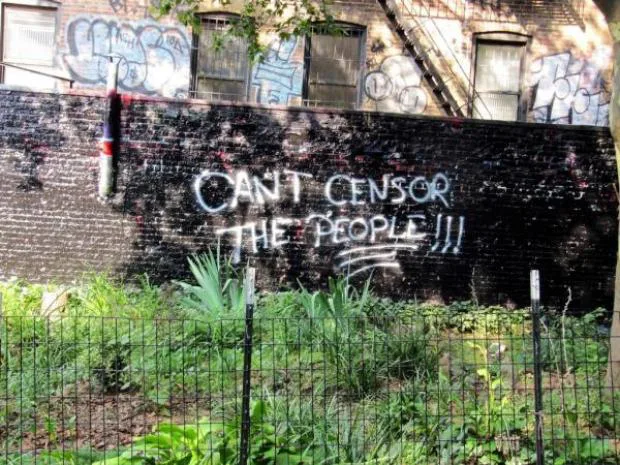
When the Smithsonian decided to remove the Wojnarowicz work, and the Museum of Contemporary Art in Los Angeles decided to paint over Blu’s anti-war mural, artists and others who have an interest in free speech protested. But in this protest we find two separate interests: one, art as a humanistic discipline, that when coupled with freedom of speech gives us the capacity to realize our full potential as human beings, and two, our interest in protecting property, which points to questions concerning the ownership of works of art. We understand that as artists we speak through the objects we produce and we believe we own that speech even if someone else owns the object.
Artists and institutions are increasingly using law as a weapon to protect free speech. But they are beginning to realize that this action is actually contributing to the demise of art. As in the Mass MoCA v. Buchel case, these aggressive legal maneuvers and lawsuits are affirming more and more that art has to be considered property in matters of free speech, and this moves the idea of art away from philosophical or moral principles into one of property rights.This brings the realization that the law cannot resolve this alone.
The alternative solution is to fight these patterns of censorship through political organizing. We will follow the example of the civil rights movement and come together to make our arguments to museums such as the Smithsonian and MOCA, and galleries such as Gagosian on moral and ethical grounds and not rely only on law. In this way we can fight for principles we deem important even if not protected by law. We understand the deeply troubling problems the recent events around free speech and censorship have raised. We ask that our institutions of art demonstrate their understanding of this and rethink their relationship to art and artists, and to consider the damage censorship and the silencing of speech does. We understand that the law negotiates the idea of art in terms of property rights, and if we only use the law as a tool to fight censorship or protect property rights, we will only intensify the present trend of art as commodity. This undermines what is important about art: that it expands our knowledge, deepens our understanding, and enriches our experiences. Art has a long history of contributing to our social, cultural, and political lives and this history should not be negated by actions that oppress the free exploration of ideas. We are using negotiation as the means to influence institutional practices around censorship in order to preserve these things that make art important to society. We ask our institutions to do the same, to look beyond their legal rights as autonomous agencies and help us protect the idea of art. We ask our institutions to make public declarations and include in their mission statements language that demonstrates their commitment to free speech and anti-censorship policies. We ask for this to preserve art and its legacy.
--Charles Gaines
Updates
January 10, 2011
Seeing the count climb this high feels heavy given the reality of what we are fighting against. We are exhausted but this momentum proves that the fight for our expression as more than mere property is worth the struggle.
6 Comments
once you start painting over murals its a slippery slope until everything is just bland beige paint
Money talks but it shouldnt be allowed to silence the people who make culture move forward
it’s sad seeing museums act like corporate PR firms instead of actual curators
THEY ARE TRYING TO ERASE HISTORY. Stop bowing down to donors and let the work stay up.
Art isnt supposed to be comfy. If you want pretty pictures go buy a calendar.
Sign Petition
We never post to your account. Social sign-in is used only to verify your signature.
Add a comment?
Your signature will be added via . Tell others why you're signing — it's optional.
By signing, you accept our Terms and Privacy Policy and agree to occasional emails about petitions. Unsubscribe anytime.
Share this petition
Share this petition to help it reach more people.
Your share link
When the Smithsonian decided to remove the Wojnarowicz work, and the Museum of Contemporary Art in Los Angeles decided to paint over Blu’s anti-war mural, artists and others who have an interest in free speech protested. But in this protest we find two separate interests: one, art as a humanistic discipline, that when coupled with freedom of speech gives us the capacity to realize our full potential as human beings, and two, our interest in protecting property, which points to questions concerning the ownership of works of art. We understand that as artists we speak through the objects we produce and we believe we own that speech even if someone else owns the object.
Artists and institutions are increasingly using law as a weapon to protect free speech. But they are beginning to realize that this action is actually contributing to the demise of art. As in the Mass MoCA v. Buchel case, these aggressive legal maneuvers and lawsuits are affirming more and more that art has to be considered property in matters of free speech, and this moves the idea of art away from philosophical or moral principles into one of property rights.This brings the realization that the law cannot resolve this alone.
The alternative solution is to fight these patterns of censorship through political organizing. We will follow the example of the civil rights movement and come together to make our arguments to museums such as the Smithsonian and MOCA, and galleries such as Gagosian on moral and ethical grounds and not rely only on law. In this way we can fight for principles we deem important even if not protected by law. We understand the deeply troubling problems the recent events around free speech and censorship have raised. We ask that our institutions of art demonstrate their understanding of this and rethink their relationship to art and artists, and to consider the damage censorship and the silencing of speech does. We understand that the law negotiates the idea of art in terms of property rights, and if we only use the law as a tool to fight censorship or protect property rights, we will only intensify the present trend of art as commodity. This undermines what is important about art: that it expands our knowledge, deepens our understanding, and enriches our experiences. Art has a long history of contributing to our social, cultural, and political lives and this history should not be negated by actions that oppress the free exploration of ideas. We are using negotiation as the means to influence institutional practices around censorship in order to preserve these things that make art important to society. We ask our institutions to do the same, to look beyond their legal rights as autonomous agencies and help us protect the idea of art. We ask our institutions to make public declarations and include in their mission statements language that demonstrates their commitment to free speech and anti-censorship policies. We ask for this to preserve art and its legacy.
--Charles Gaines
Updates
January 10, 2011
Seeing the count climb this high feels heavy given the reality of what we are fighting against. We are exhausted but this momentum proves that the fight for our expression as more than mere property is worth the struggle.
6 Comments
Woe to those who fear the examination of humanity's underbelly as though a blindfold cures all ills.
once you start painting over murals its a slippery slope until everything is just bland beige paint
Money talks but it shouldnt be allowed to silence the people who make culture move forward
it’s sad seeing museums act like corporate PR firms instead of actual curators
THEY ARE TRYING TO ERASE HISTORY. Stop bowing down to donors and let the work stay up.
Art isnt supposed to be comfy. If you want pretty pictures go buy a calendar.
Help this petition grow
Share it with friends to help reach 100 signatures.
Sign Petition
We never post to your account. Social sign-in is used only to verify your signature.
Add a comment?
Your signature will be added via .
Tell others why you're signing — it's optional.
Signing with Google or Facebook verifies your signature instantly — no email needed.
By signing, you accept our Terms and Privacy Policy and agree to occasional emails about petitions. Unsubscribe anytime.
Share this petition
Share this petition to help it reach more people.
Your share link
Petitions like this
Other petitions you might want to support





Scan to share
Anyone who scans this can sign the petition.
Woe to those who fear the examination of humanity's underbelly as though a blindfold cures all ills.