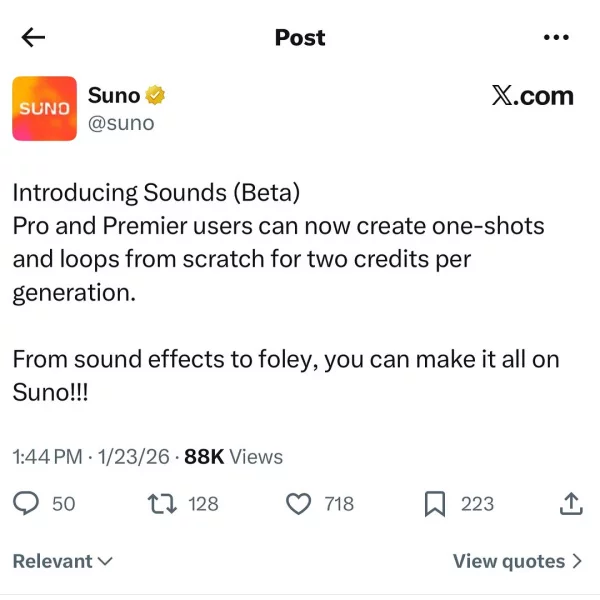
Ban Loops and One-Shot Generation on Suno AI

 Maxine K. signed
just now
Adam B. signed
just now
Maxine K. signed
just now
Adam B. signed
just now
We, the undersigned music professionals, producers, composers, sound designers, and industry stakeholders, formally request that Suno AI implement an immediate ban on the generation of loops and one-shot audio samples within its platform.
While generative AI can support creativity when applied responsibly, the unrestricted generation of loops and one-shots introduces critical ethical, legal, cultural, and economic risks that threaten the long-term integrity of the music production ecosystem.
Key Issues
1. Intellectual Property and Copyright Violations
Loops and one-shots are designed for direct reuse and commercial deployment. AI-generated samples risk reproducing copyrighted material, stylistic signatures, or proprietary sound design assets, resulting in large-scale, untraceable infringement.
2. Dataset Contamination and Sample Laundering
AI-generated samples can be reintroduced into training datasets, causing recursive contamination. This enables “sample laundering,” permanently severing the connection between original creators and their work, eroding ownership and attribution.
3. Market Saturation and Devaluation of Sound Design
Unlimited AI-generated loops flood marketplaces with interchangeable content, collapsing the economic value of professionally crafted sample libraries and destabilizing sustainable creative careers.
4. Legal Ambiguity for Artists, Labels, and Publishers
Loops and one-shots are routinely embedded in commercial releases. The lack of verifiable provenance exposes artists and rights holders to takedowns, disputes, and litigation stemming from unknowingly using AI-generated material.
5. Loss of Accountability and Attribution
Once exported, loops and one-shots are modular, anonymous, and untraceable. This makes licensing enforcement, ethical use, and rights management effectively impossible.
6. Homogenization of Musical Language
Loop-based generation accelerates repetition, predictability, and stylistic convergence, reducing sonic diversity and pushing music toward algorithmic uniformity rather than artistic exploration.
7. Loss of Originality and Creative Identity
The widespread availability of AI-generated loops discourages intentional sound design and personal experimentation. Instead of cultivating a unique sonic identity, creators are incentivized to assemble prefabricated outputs, weakening originality at both individual and industry levels.
8. Erosion of the Craft of Building Sample Kits
Creating one-shot kits, drum kits, and loop libraries is a foundational discipline in modern music production. Automating this process removes the educational, artistic, and cultural value of crafting sounds from scratch, diminishing producers’ technical growth and long-term creative competence.
9. Cultural Devaluation of the Producer’s Role
When core building blocks are generated instantly, the producer’s role shifts from creator to assembler. This undermines the professional identity of producers and reduces music creation to procedural output rather than deliberate artistic authorship.
10. Misalignment with Responsible AI Principles
Permitting loop and one-shot generation prioritizes volume over accountability, contradicting emerging standards for responsible AI deployment, transparency, and creator protection.
Our Request
We respectfully urge Suno AI to:
- Permanently disable the generation of loops and one-shot samples
- Restrict AI output to full, non-modular compositions
- Protect originality, authorship, and creative skill development
- Preserve the cultural and professional value of sound design
- Align platform policies with international copyright and AI governance standards


Enter your details on the next page