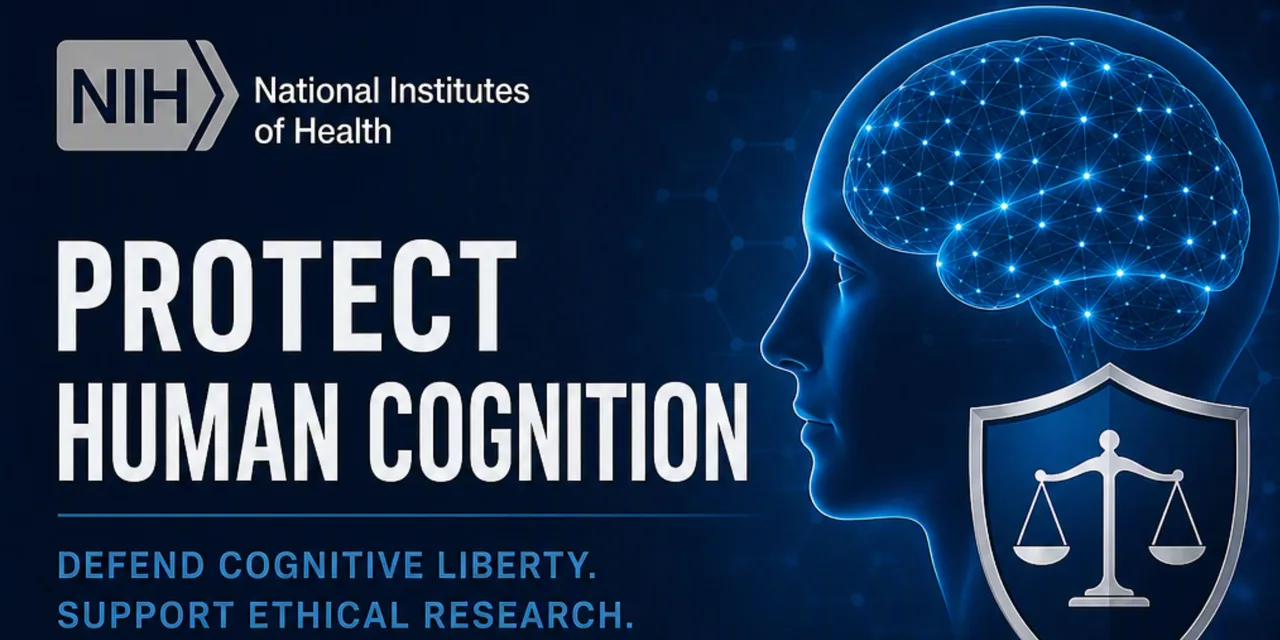
Protect Human Cognition, Halt Harmful Cognitive Experiments, and Establish National Cognitive‑Privacy Policies
Submitted by Advocacy for Neuro Rights Inc.
Introduction
Human cognition is the core of autonomy, identity, and human dignity. It is the foundation of every decision we make, every intention we form, and every private thought we hold. Yet in the United States, cognition remains almost entirely unprotected by federal law. Emerging technologies now possess the ability to infer mental states, predict intentions, classify emotions, and model internal cognitive processes. These capabilities are advancing faster than ethical guidelines, faster than public awareness, and faster than the legal protections needed to safeguard the American people.
Advocacy for Neuro Rights Inc. submits this petition to the National Institutes of Health (NIH) to call for immediate action. As the nation’s leading biomedical authority, NIH carries immense influence. Its policies shape scientific ethics, guide research standards, and set expectations for responsible innovation across the United States. Because of this, NIH must lead the nation in recognizing cognition as a sensitive biological domain requiring protection, transparency, and strict oversight.
Why This Petition Is Necessary
For decades, federal initiatives such as the Decade of the Brain and the BRAIN Initiative have encouraged rapid expansion of neuroscience, neurotechnology, and AI‑driven cognitive research. These programs advanced scientific understanding, but they did not establish protections for mental privacy or cognitive liberty.
As a result, institutions across government, academia, and private industry can legally infer human cognition without violating any federal statute. They can model mental states, predict intentions, and analyze neural‑signal patterns under the umbrella of “research,” even when the public is unaware of the risks.
This gap exposes vulnerable populations to technologies capable of accessing internal mental processes. Individuals who are medically vulnerable, economically disadvantaged, or socially marginalized are at heightened risk of being monitored, analyzed, or experimented on without fully understanding the implications. Without protective policies, cognitive‑inference technologies can create new vulnerable populations, deepen existing inequities, and cause long‑term harm through longitudinal monitoring or behavioral prediction.
The absence of cognitive‑privacy laws allows private companies, investors, and research institutions to develop systems capable of inferring cognition without meaningful oversight. These systems can be used for commercial gain, behavioral targeting, surveillance, or experimental research. Cognition the most intimate aspect of human life must never become a commodity.
Our Petition to the NIH
Advocacy for Neuro Rights Inc. respectfully petitions the NIH to take decisive action to protect human cognition and ensure that emerging technologies do not compromise the rights and freedoms of the American people.
We call on the NIH to halt harmful cognitive experiments until protective policies are established. Research involving mental‑state inference, intention prediction, cognitive manipulation, neural‑signal extraction, and AI‑driven cognitive profiling must be paused until ethical safeguards are in place. The public must be protected from research that has the potential to harm vulnerable populations or create new forms of exploitation.
We call on the NIH to establish internal policies that recognize cognition as a sensitive biological domain.
These policies must protect cognitive states and neuro‑data from misuse, prohibit unauthorized cognitive inference, and ensure that all cognitive research undergoes strict ethical review. NIH must take responsibility for ensuring that federally funded research does not create technologies that can harm individuals or communities.
We call on the NIH to require explicit informed consent for all cognitive research. Consent must be clear, transparent, and understandable.
Participants must be fully informed when research involves cognitive‑state inference, neural‑signal modeling, AI‑driven cognitive analysis, or any procedure capable of accessing mental states. Informed consent must be upheld as a fundamental right.
We call on the NIH to issue public statements affirming cognitive liberty, mental privacy, and freedom of thought. These values are foundational to human rights and must be recognized at the federal level. The public deserves assurance that NIH will protect autonomy and safeguard cognition from unauthorized interference.
We call on the NIH to strengthen IRB oversight nationwide.
Institutional Review Boards must treat cognition as a protected human‑subject category. IRBs must tighten approvals for cognitive research, prohibit inference on vulnerable populations, prevent longitudinal cognitive monitoring without consent, and enforce 45 CFR 46 protections for cognitive autonomy. IRBs must block research that could create new vulnerable populations or expose individuals to harmful cognitive‑inference technologies.
We call on the NIH to advocate for policies that restrict private companies and investors from inferring cognition. No private entity should be allowed to collect cognitive data, infer mental states, or commercialize cognitive‑inference technologies without strict oversight. Marketing, advertising, and data‑sharing practices must never exploit human cognition.
We call on the NIH to promote regulatory oversight for cognitive technologies. NIH must work with federal partners to establish national cognitive‑privacy standards, regulate AI‑driven cognitive inference, oversee neurotechnology capable of accessing mental states, and ensure public protection from emerging cognitive systems. This includes AI, BCI, neurotech, biometric inference systems, cognitive‑computing platforms, and any technology capable of accessing or modeling human cognition.
Why NIH Must Act Now
NIH is uniquely positioned to lead the nation in establishing cognitive protections. Its policies influence universities, research institutions, private companies, and federal agencies. Without NIH leadership, cognitive‑privacy protections will remain absent from U.S. law, leaving millions of Americans exposed to technologies capable of accessing their internal mental world.
NIH must act not only to protect research participants, but also to protect the public from technologies derived from federally funded research. The absence of cognitive‑privacy laws combined with rapid advances in AI, neurotechnology, and behavioral prediction creates an urgent need for NIH to establish protective policies and halt harmful cognitive experimentation.
Closing Statement
Human cognition is sacred. It is the core of autonomy, identity, and human dignity. No institution, company, or government should have the ability to infer thoughts, intentions, or mental states without explicit consent and strict oversight. Advocacy for Neuro Rights Inc. calls on the NIH to lead the nation in protecting cognitive liberty, establishing ethical safeguards, and ensuring that emerging technologies do not compromise the rights and freedoms of the American people.
We petition the NIH to halt harmful cognitive research, establish protective policies, strengthen IRB oversight, and publicly affirm its commitment to safeguarding cognition across the United States.
Your mind is your last sanctuary. It must be protected.
5 Comments

To help Targeted Individuals
As an neurodevelopmental, trauma-informed advocate, our neurodivergent children are being psychologically harmed every day by forcing them into the indoctrination that neurotypical brains comply with easily. Disability Rights are Human Rights and Human Rights are God-given for all.
Technology is so much more advanced than laws.
Neural Anonymity
Sign Petition
We never post to your account. Social sign-in is used only to verify your signature.
Add a comment?
Your signature will be added via . Tell others why you're signing — it's optional.
By signing, you accept our Terms and Privacy Policy and agree to occasional emails about petitions. Unsubscribe anytime.
Share this petition
Share this petition to help it reach more people.
Your share link
 Decision Makers:
Jay Bhattacharya
Decision Makers:
Jay Bhattacharya
Protect Human Cognition, Halt Harmful Cognitive Experiments, and Establish National Cognitive‑Privacy Policies
Submitted by Advocacy for Neuro Rights Inc.
Introduction
Human cognition is the core of autonomy, identity, and human dignity. It is the foundation of every decision we make, every intention we form, and every private thought we hold. Yet in the United States, cognition remains almost entirely unprotected by federal law. Emerging technologies now possess the ability to infer mental states, predict intentions, classify emotions, and model internal cognitive processes. These capabilities are advancing faster than ethical guidelines, faster than public awareness, and faster than the legal protections needed to safeguard the American people.
Advocacy for Neuro Rights Inc. submits this petition to the National Institutes of Health (NIH) to call for immediate action. As the nation’s leading biomedical authority, NIH carries immense influence. Its policies shape scientific ethics, guide research standards, and set expectations for responsible innovation across the United States. Because of this, NIH must lead the nation in recognizing cognition as a sensitive biological domain requiring protection, transparency, and strict oversight.
Why This Petition Is Necessary
For decades, federal initiatives such as the Decade of the Brain and the BRAIN Initiative have encouraged rapid expansion of neuroscience, neurotechnology, and AI‑driven cognitive research. These programs advanced scientific understanding, but they did not establish protections for mental privacy or cognitive liberty.
As a result, institutions across government, academia, and private industry can legally infer human cognition without violating any federal statute. They can model mental states, predict intentions, and analyze neural‑signal patterns under the umbrella of “research,” even when the public is unaware of the risks.
This gap exposes vulnerable populations to technologies capable of accessing internal mental processes. Individuals who are medically vulnerable, economically disadvantaged, or socially marginalized are at heightened risk of being monitored, analyzed, or experimented on without fully understanding the implications. Without protective policies, cognitive‑inference technologies can create new vulnerable populations, deepen existing inequities, and cause long‑term harm through longitudinal monitoring or behavioral prediction.
The absence of cognitive‑privacy laws allows private companies, investors, and research institutions to develop systems capable of inferring cognition without meaningful oversight. These systems can be used for commercial gain, behavioral targeting, surveillance, or experimental research. Cognition the most intimate aspect of human life must never become a commodity.
Our Petition to the NIH
Advocacy for Neuro Rights Inc. respectfully petitions the NIH to take decisive action to protect human cognition and ensure that emerging technologies do not compromise the rights and freedoms of the American people.
We call on the NIH to halt harmful cognitive experiments until protective policies are established. Research involving mental‑state inference, intention prediction, cognitive manipulation, neural‑signal extraction, and AI‑driven cognitive profiling must be paused until ethical safeguards are in place. The public must be protected from research that has the potential to harm vulnerable populations or create new forms of exploitation.
We call on the NIH to establish internal policies that recognize cognition as a sensitive biological domain.
These policies must protect cognitive states and neuro‑data from misuse, prohibit unauthorized cognitive inference, and ensure that all cognitive research undergoes strict ethical review. NIH must take responsibility for ensuring that federally funded research does not create technologies that can harm individuals or communities.
We call on the NIH to require explicit informed consent for all cognitive research. Consent must be clear, transparent, and understandable.
Participants must be fully informed when research involves cognitive‑state inference, neural‑signal modeling, AI‑driven cognitive analysis, or any procedure capable of accessing mental states. Informed consent must be upheld as a fundamental right.
We call on the NIH to issue public statements affirming cognitive liberty, mental privacy, and freedom of thought. These values are foundational to human rights and must be recognized at the federal level. The public deserves assurance that NIH will protect autonomy and safeguard cognition from unauthorized interference.
We call on the NIH to strengthen IRB oversight nationwide.
Institutional Review Boards must treat cognition as a protected human‑subject category. IRBs must tighten approvals for cognitive research, prohibit inference on vulnerable populations, prevent longitudinal cognitive monitoring without consent, and enforce 45 CFR 46 protections for cognitive autonomy. IRBs must block research that could create new vulnerable populations or expose individuals to harmful cognitive‑inference technologies.
We call on the NIH to advocate for policies that restrict private companies and investors from inferring cognition. No private entity should be allowed to collect cognitive data, infer mental states, or commercialize cognitive‑inference technologies without strict oversight. Marketing, advertising, and data‑sharing practices must never exploit human cognition.
We call on the NIH to promote regulatory oversight for cognitive technologies. NIH must work with federal partners to establish national cognitive‑privacy standards, regulate AI‑driven cognitive inference, oversee neurotechnology capable of accessing mental states, and ensure public protection from emerging cognitive systems. This includes AI, BCI, neurotech, biometric inference systems, cognitive‑computing platforms, and any technology capable of accessing or modeling human cognition.
Why NIH Must Act Now
NIH is uniquely positioned to lead the nation in establishing cognitive protections. Its policies influence universities, research institutions, private companies, and federal agencies. Without NIH leadership, cognitive‑privacy protections will remain absent from U.S. law, leaving millions of Americans exposed to technologies capable of accessing their internal mental world.
NIH must act not only to protect research participants, but also to protect the public from technologies derived from federally funded research. The absence of cognitive‑privacy laws combined with rapid advances in AI, neurotechnology, and behavioral prediction creates an urgent need for NIH to establish protective policies and halt harmful cognitive experimentation.
Closing Statement
Human cognition is sacred. It is the core of autonomy, identity, and human dignity. No institution, company, or government should have the ability to infer thoughts, intentions, or mental states without explicit consent and strict oversight. Advocacy for Neuro Rights Inc. calls on the NIH to lead the nation in protecting cognitive liberty, establishing ethical safeguards, and ensuring that emerging technologies do not compromise the rights and freedoms of the American people.
We petition the NIH to halt harmful cognitive research, establish protective policies, strengthen IRB oversight, and publicly affirm its commitment to safeguarding cognition across the United States.
Your mind is your last sanctuary. It must be protected.
5 Comments
We have lost all rights to privacy, even in places where we still presume to have a reasonable expectation of privacy. There has to be something about being a human being that remains sacred. There has to be one place where we can feel safe from harm, even if that is not a physical but a mental space.
To help Targeted Individuals
As an neurodevelopmental, trauma-informed advocate, our neurodivergent children are being psychologically harmed every day by forcing them into the indoctrination that neurotypical brains comply with easily. Disability Rights are Human Rights and Human Rights are God-given for all.
Technology is so much more advanced than laws.
Neural Anonymity
Help this petition grow
Share it with friends to help reach 50 signatures.
Sign Petition
We never post to your account. Social sign-in is used only to verify your signature.
Add a comment?
Your signature will be added via .
Tell others why you're signing — it's optional.
Signing with Google or Facebook verifies your signature instantly — no email needed.
By signing, you accept our Terms and Privacy Policy and agree to occasional emails about petitions. Unsubscribe anytime.
Share this petition
Share this petition to help it reach more people.
Your share link
Petitions like this
Other petitions you might want to support




Scan to share
Anyone who scans this can sign the petition.
We have lost all rights to privacy, even in places where we still presume to have a reasonable expectation of privacy. There has to be something about being a human being that remains sacred. There has to be one place where we can feel safe from harm, even if that is not a physical but a mental space.