CANADA DOES NOT WELCOME CORRUPTION
PETITION TO THE MINISTER OF JUSTICE AND ATTORNEY GENERAL OF CANADA
Demand Immediate Action Concerning the Alleged Miscarriage of Justice and Continued Imprisonment of Daylo Robinson
To the Honourable Minister of Justice and Attorney General of Canada:
We, the undersigned family members, friends, supporters, and concerned members of the Canadian public, call upon the Minister of Justice and Attorney General of Canada to take every lawful step available within federal authority to ensure that the extraordinary allegations arising from the prosecution, conviction, sentencing, and continued imprisonment of Daylo Robinson receive meaningful, independent and transparent scrutiny.
Daylo Robinson has been incarcerated since May 10, 2018.
Following his second jury trial, he was convicted of serious offences. On June 12, 2026, he was declared a Dangerous Offender and sentenced to indeterminate detention.
His convictions and sentence are under appellate challenge.
But the issue now confronting his family and supporters extends beyond ordinary disagreement with a verdict.
The accumulated court record raises allegations involving:
prosecutorial misconduct, disclosure failures, disputed forensic evidence, inconsistent treatment of physical evidence, interference with the defence’s ability to confront important evidence, alleged judicial unfairness, and cumulative prejudice affecting the reliability of the proceedings.
These allegations are capable of being tested against transcripts, exhibits, disclosure records, police documentation and digital-forensic materials.
They should be tested.
Canada cannot credibly proclaim commitment to the rule of law while serious, documented allegations concerning the conduct of state actors are left unanswered.
MINISTER, WE ARE ASKING YOU TO LOOK AT THE RECORD
This petition does not ask you to interfere with the independence of the courts.
It does not ask you to decide Daylo Robinson’s appeal.
It does not ask you to substitute political authority for judicial authority.
It asks something both simpler and more fundamental:
Do not permit credible allegations of serious state misconduct and a cumulative miscarriage of justice to disappear between institutional jurisdictions while a Canadian remains imprisoned.
Where matters fall within provincial jurisdiction, we ask you to formally engage the authorities possessing jurisdiction.
Where matters disclose broader concerns about the administration of criminal justice in Canada, we ask you to exercise the leadership responsibilities of your office.
Where evidence identifies potentially unlawful conduct, we ask that it be preserved and referred to the institution legally authorized to investigate it.
And where the integrity of Canada’s justice system is implicated, we ask that silence not become the institutional response.
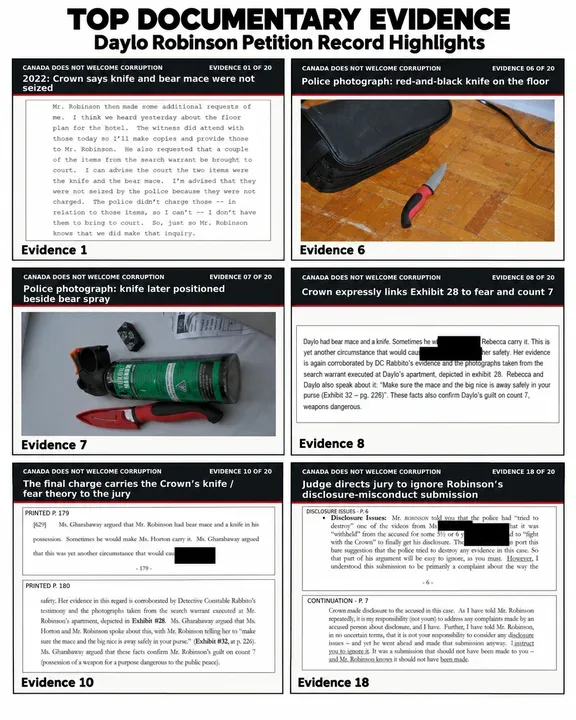
THE RED KNIFE
One of the clearest examples concerns a red-and-black handled knife appearing in the evidentiary record.
During earlier proceedings, Crown counsel acknowledged in court that the photographed knife was not related to the charges being prosecuted.
That fact matters enormously.
During the later jury trial, however, imagery concerning the red-handled knife was placed before the jury while Robinson was being prosecuted on allegations involving weapons, fear, control and human trafficking.
Robinson objected.
The prosecution had already possessed information distinguishing that knife from the alleged offences.
Yet the jury was nevertheless exposed to imagery capable of portraying Robinson as armed, threatening or dangerous.
That raises an obvious and deeply troubling question:
Why was evidence previously acknowledged to be unrelated to the charged conduct subsequently placed before the jury in a prosecution where precisely that imagery could materially influence the jury’s perception of the accused?
If the documentary record establishes that state counsel knew the knife was unrelated and nevertheless presented it in a materially misleading manner before the jury, that conduct deserves independent examination.
This is not about a technicality.
It is about the integrity of a criminal trial.
DISCLOSURE AFTER THE OPPORTUNITY TO USE IT WAS GONE
The case also raises serious concerns concerning disclosure.
A central prosecution witness, R.W., stopped participating during cross-examination at the 2019 preliminary inquiry.
Her cross-examination was never completed.
Nevertheless, portions of her earlier evidence later became part of the prosecution case.
Material capable of being used to investigate, challenge, confront or impeach her subsequently became the subject of disclosure disputes.
Among those materials was a video identified as:
IMG_2990.mov
The video had been specifically addressed during the preliminary-inquiry proceedings.
Robinson maintains that despite its importance, it was not disclosed to him until the second trial years later.
The distinction is fundamental.
Evidence disclosed after a witness can no longer be questioned is not necessarily equivalent to evidence disclosed while meaningful cross-examination remains possible.
Once the opportunity to confront a witness has disappeared, later disclosure cannot automatically recreate that lost constitutional opportunity.
The Minister should be concerned whenever the timing of state disclosure potentially transforms evidence from something an accused could actually use into something the accused can merely look at after the damage has occurred.
THE HORTON PHONE AND DIGITAL-FORENSIC EVIDENCE
There are also substantial unresolved questions concerning cellphone evidence seized during the investigation.
The relevant history includes:
- seizure of the Horton cellphone during the 2018 investigation;
- a Cellebrite extraction associated with November 5, 2018;
- subsequent warrant proceedings;
- a further warrant dated March 12, 2019;
- later Cellebrite activity during 2019;
- forensic materials containing source categories identified as Legacy, Logical (1), Logical (2) and filesystem-related material;
- disputes concerning the provenance and chronology of the digital evidence ultimately presented before the courts.
These issues directly concern the constitutional legality and evidentiary reliability of material relied upon by the state.
Digital evidence does not become trustworthy merely because a forensic program produced a report.
Its provenance matters.
Its acquisition date matters.
Its source matters.
The authority under which it was obtained matters.
The distinction between acquired data, imported data, previously extracted data and subsequently processed data matters.
And where a court is asked to determine whether digital evidence was constitutionally obtained, the factual history supplied to that court must be accurate and complete.
If later forensic records or testimony demonstrate that the factual foundation presented during an earlier constitutional hearing was materially incomplete or inaccurate, that issue deserves serious independent scrutiny.
THIS CASE MUST BE EXAMINED CUMULATIVELY
The central concern of this petition is not that one isolated error occurred.
The concern is the accumulation of events.
The record has raised allegations involving:
- delayed or disputed disclosure;
- incomplete cross-examination of an important prosecution witness;
- subsequent use of that witness’s prior evidence;
- allegedly late disclosure of impeachment material;
- unresolved digital-forensic provenance issues;
- inconsistencies involving physical evidence;
- presentation of the red-handled knife despite its previously acknowledged lack of connection to the alleged offences;
- disputes concerning restrictions and corrective instructions imposed upon Robinson’s closing submissions;
- allegations that prosecution and defence submissions were treated differently before the jury;
- post-trial evidence and testimony said to materially affect the factual basis upon which earlier rulings had been made;
- continuing difficulties obtaining and accessing material required to meaningfully pursue appellate remedies.
A justice system cannot adequately investigate an alleged miscarriage of justice by separating every incident into an isolated compartment and declaring each individually harmless.
The question must also be:
What was the cumulative effect?
What did the jury ultimately hear?
What did it not hear?
What information was available to state actors?
When was it available?
What was disclosed to the defence?
What was disclosed to the court?
What opportunities to challenge the prosecution’s case were permanently lost?
And did the combined effect undermine the reliability and fairness of the proceeding?
PROSECUTORIAL POWER REQUIRES ACCOUNTABILITY
Canadian prosecutors exercise extraordinary authority.
Their function is not simply to secure convictions.
They act in the public interest and are expected to conduct prosecutions fairly.
That obligation matters most when allegations are serious and emotions run high.
The prosecution of Daylo Robinson must therefore withstand examination not merely of whether individual decisions can be defended in isolation, but whether the state consistently fulfilled its obligations throughout the proceeding.
Where evidence shows that the prosecution possessed information inconsistent with a position subsequently advanced before a jury, that contradiction must be explained.
Where relevant evidence was disclosed only after meaningful opportunities to use it disappeared, that chronology must be examined.
Where forensic provenance differs from the factual narrative supplied to a court, the discrepancy must be investigated.
And where inflammatory physical evidence was presented despite prior knowledge that it was unrelated to the alleged offence, the public is entitled to know why.
JUDICIAL INDEPENDENCE DOES NOT MEAN ABSENCE OF ACCOUNTABILITY
We fully recognize the constitutional importance of judicial independence.
This petition does not ask the Minister of Justice to direct a judge, overturn a judicial decision, or interfere with the appellate courts.
But judicial independence cannot mean that documented allegations concerning judicial conduct are forbidden from scrutiny by the institutions lawfully responsible for receiving and examining such complaints.
Robinson and his supporters allege that aspects of the proceedings—including evidentiary decisions, treatment of defence submissions, jury instructions and other judicial conduct—contributed to a cumulative unfairness.
Those allegations should be measured against the actual record.
Where the appropriate forum is the appellate courts, the appellate process must remain meaningful.
Where the appropriate forum is the Canadian Judicial Council or another authorized body, the evidence should reach that body.
Jurisdiction should determine where an allegation is examined.
It should never become the reason why nobody examines it at all.
MORE THAN EIGHT YEARS OF LIBERTY
Daylo Robinson has been incarcerated since May 10, 2018.
By October 2026, more than eight years of his life have been spent in custody.
His present sentence is indeterminate.
Every day therefore matters.
If the convictions and sentence withstand full and fair appellate scrutiny, the justice system will have had the opportunity to demonstrate their reliability.
But if disclosure failures, evidentiary irregularities, forensic problems, prosecutorial misconduct or judicial unfairness contributed to an unsafe conviction, continued incarceration magnifies the consequences of the original wrong.
Justice delayed in those circumstances is not abstract.
It is measured in days of human liberty.
MINISTER, CANADA CANNOT ALLOW INSTITUTIONS TO PROTECT ONE ANOTHER FROM SCRUTINY
This petition presents a broader question about the Canadian justice system.
What happens when allegations involve numerous institutions simultaneously?
Police point toward prosecutors.
Prosecutors point toward court rulings.
Courts point toward appellate remedies.
Professional bodies say matters belong elsewhere.
Government departments invoke jurisdiction.
And meanwhile the person alleging the miscarriage of justice remains imprisoned.
That cannot become a circle from which accountability is impossible.
Federalism, prosecutorial independence and judicial independence are essential constitutional principles.
None should become a shield protecting documented wrongdoing from lawful investigation.
WE CALL UPON THE MINISTER OF JUSTICE AND ATTORNEY GENERAL OF CANADA TO:
- Formally acknowledge and review the materials submitted concerning the alleged cumulative miscarriage of justice in the prosecution of Daylo Robinson.
- Identify every matter falling within federal jurisdiction and ensure that it is referred to, reviewed by, or brought to the attention of the appropriate federal authority.
- Where allegations fall within Ontario jurisdiction, formally communicate the documented concerns to the Attorney General of Ontario and other competent provincial authorities and request that they receive appropriate independent consideration.
- Take all lawful steps available to promote preservation of evidence relevant to the allegations, including digital-forensic source material, disclosure records, police records, prosecution records, photographs, video and other records whose destruction could prevent later independent examination.
- Ensure that allegations potentially engaging federal criminal law are directed to the investigative or prosecutorial authority legally competent to assess them, without prejudging whether an offence has occurred.
- Request appropriate scrutiny of the disclosure chronology, including the timing of IMG_2990.mov and other material potentially affecting Robinson’s ability to confront prosecution evidence.
- Request appropriate independent technical examination of the Horton cellphone evidence, including extraction provenance, source containers, acquisition chronology, Cellebrite metadata and the relationship between the forensic record and representations subsequently made before the courts.
- Ensure that allegations concerning prosecutorial conduct are brought before the professional or governmental institutions legally empowered to investigate them.
- Ensure that allegations concerning judicial conduct are capable of reaching the Canadian Judicial Council or other competent body without interfering with adjudicative independence.
- Support meaningful and timely access to appellate justice, including access to the transcripts, exhibits and court records necessary for an incarcerated appellant to properly exercise his legal rights.
- Consider whether the accumulated allegations reveal systemic issues extending beyond this individual prosecution, particularly regarding disclosure, preservation of digital evidence, forensic provenance and accountability where multiple justice institutions are implicated.
- Provide a substantive public or written response identifying what lawful action can be taken, what referrals have been made, and which authorities possess jurisdiction over matters outside the Minister’s direct authority.
WE ARE NOT ASKING FOR POLITICAL INTERFERENCE
We are asking for political leadership in defence of the rule of law.
There is an enormous difference.
The Minister must not decide Robinson’s guilt or innocence.
The Minister must not tell an appellate court what judgment to reach.
The Minister must not direct an independent prosecutor to obtain a particular result.
But the Minister of Justice of Canada should not be indifferent when citizens present documentary evidence suggesting that multiple components of the justice system may have failed simultaneously.
The appropriate response is not:
“That belongs to someone else.”
The appropriate response is:
“Who has lawful jurisdiction, has the evidence been preserved, has that authority received it, and will the allegations actually be examined?”
CANADA DOES NOT WELCOME CORRUPTION
Canada’s commitment to the rule of law cannot exist only in speeches.
It must survive difficult cases.
It must survive embarrassing allegations.
It must survive scrutiny of police.
It must survive scrutiny of prosecutors.
It must survive scrutiny of judges.
And it must survive the possibility that institutions of justice themselves made grave mistakes.
No person should receive special treatment because they are powerful.
No person should receive less protection because they are accused of unpopular offences.
No institution should be permitted to protect its reputation at the expense of discovering the truth.
We therefore ask the Minister of Justice and Attorney General of Canada to act within the full lawful authority of that office to ensure that the evidence concerning the prosecution and continued incarceration of Daylo Robinson does not disappear into an institutional void.
Preserve the evidence.
Require accountability.
Ensure independent scrutiny.
Protect the integrity of Canadian justice.
And where wrongdoing is established, ensure that it is addressed through the institutions empowered by law to do so.
CANADA DOES NOT WELCOME CORRUPTION.
Justice for Daylo Robinson.
Accountability for the Record.
Independent Scrutiny Now.
We, the undersigned, call upon the Minister of Justice and Attorney General of Canada to formally respond to this petition and ensure that the documented allegations surrounding Daylo Robinson’s prosecution and continued imprisonment are placed before every competent authority necessary for a complete, independent and
transparent examination. Link to evidence
https://www.reddit.com/r/daylor/s/aWNswZRi1i
3 Comments

Love you DayDay, this a win for you, comming home soon. Sooo much wrong has been done by " the system" currupted.
I believe he was wrongly accused
Sign Petition
We never post to your account. Social sign-in is used only to verify your signature.
Add a comment?
Your signature will be added via . Tell others why you're signing — it's optional.
By signing, you accept our Terms and Privacy Policy and agree to occasional emails about petitions. Unsubscribe anytime.
Share this petition
Share this petition to help it reach more people.
Your share link
 Decision Makers:
Minister of Justice
Decision Makers:
Minister of Justice
CANADA DOES NOT WELCOME CORRUPTION
PETITION TO THE MINISTER OF JUSTICE AND ATTORNEY GENERAL OF CANADA
Demand Immediate Action Concerning the Alleged Miscarriage of Justice and Continued Imprisonment of Daylo Robinson
To the Honourable Minister of Justice and Attorney General of Canada:
We, the undersigned family members, friends, supporters, and concerned members of the Canadian public, call upon the Minister of Justice and Attorney General of Canada to take every lawful step available within federal authority to ensure that the extraordinary allegations arising from the prosecution, conviction, sentencing, and continued imprisonment of Daylo Robinson receive meaningful, independent and transparent scrutiny.
Daylo Robinson has been incarcerated since May 10, 2018.
Following his second jury trial, he was convicted of serious offences. On June 12, 2026, he was declared a Dangerous Offender and sentenced to indeterminate detention.
His convictions and sentence are under appellate challenge.
But the issue now confronting his family and supporters extends beyond ordinary disagreement with a verdict.
The accumulated court record raises allegations involving:
prosecutorial misconduct, disclosure failures, disputed forensic evidence, inconsistent treatment of physical evidence, interference with the defence’s ability to confront important evidence, alleged judicial unfairness, and cumulative prejudice affecting the reliability of the proceedings.
These allegations are capable of being tested against transcripts, exhibits, disclosure records, police documentation and digital-forensic materials.
They should be tested.
Canada cannot credibly proclaim commitment to the rule of law while serious, documented allegations concerning the conduct of state actors are left unanswered.
MINISTER, WE ARE ASKING YOU TO LOOK AT THE RECORD
This petition does not ask you to interfere with the independence of the courts.
It does not ask you to decide Daylo Robinson’s appeal.
It does not ask you to substitute political authority for judicial authority.
It asks something both simpler and more fundamental:
Do not permit credible allegations of serious state misconduct and a cumulative miscarriage of justice to disappear between institutional jurisdictions while a Canadian remains imprisoned.
Where matters fall within provincial jurisdiction, we ask you to formally engage the authorities possessing jurisdiction.
Where matters disclose broader concerns about the administration of criminal justice in Canada, we ask you to exercise the leadership responsibilities of your office.
Where evidence identifies potentially unlawful conduct, we ask that it be preserved and referred to the institution legally authorized to investigate it.
And where the integrity of Canada’s justice system is implicated, we ask that silence not become the institutional response.
THE RED KNIFE
One of the clearest examples concerns a red-and-black handled knife appearing in the evidentiary record.
During earlier proceedings, Crown counsel acknowledged in court that the photographed knife was not related to the charges being prosecuted.
That fact matters enormously.
During the later jury trial, however, imagery concerning the red-handled knife was placed before the jury while Robinson was being prosecuted on allegations involving weapons, fear, control and human trafficking.
Robinson objected.
The prosecution had already possessed information distinguishing that knife from the alleged offences.
Yet the jury was nevertheless exposed to imagery capable of portraying Robinson as armed, threatening or dangerous.
That raises an obvious and deeply troubling question:
Why was evidence previously acknowledged to be unrelated to the charged conduct subsequently placed before the jury in a prosecution where precisely that imagery could materially influence the jury’s perception of the accused?
If the documentary record establishes that state counsel knew the knife was unrelated and nevertheless presented it in a materially misleading manner before the jury, that conduct deserves independent examination.
This is not about a technicality.
It is about the integrity of a criminal trial.
DISCLOSURE AFTER THE OPPORTUNITY TO USE IT WAS GONE
The case also raises serious concerns concerning disclosure.
A central prosecution witness, R.W., stopped participating during cross-examination at the 2019 preliminary inquiry.
Her cross-examination was never completed.
Nevertheless, portions of her earlier evidence later became part of the prosecution case.
Material capable of being used to investigate, challenge, confront or impeach her subsequently became the subject of disclosure disputes.
Among those materials was a video identified as:
IMG_2990.mov
The video had been specifically addressed during the preliminary-inquiry proceedings.
Robinson maintains that despite its importance, it was not disclosed to him until the second trial years later.
The distinction is fundamental.
Evidence disclosed after a witness can no longer be questioned is not necessarily equivalent to evidence disclosed while meaningful cross-examination remains possible.
Once the opportunity to confront a witness has disappeared, later disclosure cannot automatically recreate that lost constitutional opportunity.
The Minister should be concerned whenever the timing of state disclosure potentially transforms evidence from something an accused could actually use into something the accused can merely look at after the damage has occurred.
THE HORTON PHONE AND DIGITAL-FORENSIC EVIDENCE
There are also substantial unresolved questions concerning cellphone evidence seized during the investigation.
The relevant history includes:
- seizure of the Horton cellphone during the 2018 investigation;
- a Cellebrite extraction associated with November 5, 2018;
- subsequent warrant proceedings;
- a further warrant dated March 12, 2019;
- later Cellebrite activity during 2019;
- forensic materials containing source categories identified as Legacy, Logical (1), Logical (2) and filesystem-related material;
- disputes concerning the provenance and chronology of the digital evidence ultimately presented before the courts.
These issues directly concern the constitutional legality and evidentiary reliability of material relied upon by the state.
Digital evidence does not become trustworthy merely because a forensic program produced a report.
Its provenance matters.
Its acquisition date matters.
Its source matters.
The authority under which it was obtained matters.
The distinction between acquired data, imported data, previously extracted data and subsequently processed data matters.
And where a court is asked to determine whether digital evidence was constitutionally obtained, the factual history supplied to that court must be accurate and complete.
If later forensic records or testimony demonstrate that the factual foundation presented during an earlier constitutional hearing was materially incomplete or inaccurate, that issue deserves serious independent scrutiny.
THIS CASE MUST BE EXAMINED CUMULATIVELY
The central concern of this petition is not that one isolated error occurred.
The concern is the accumulation of events.
The record has raised allegations involving:
- delayed or disputed disclosure;
- incomplete cross-examination of an important prosecution witness;
- subsequent use of that witness’s prior evidence;
- allegedly late disclosure of impeachment material;
- unresolved digital-forensic provenance issues;
- inconsistencies involving physical evidence;
- presentation of the red-handled knife despite its previously acknowledged lack of connection to the alleged offences;
- disputes concerning restrictions and corrective instructions imposed upon Robinson’s closing submissions;
- allegations that prosecution and defence submissions were treated differently before the jury;
- post-trial evidence and testimony said to materially affect the factual basis upon which earlier rulings had been made;
- continuing difficulties obtaining and accessing material required to meaningfully pursue appellate remedies.
A justice system cannot adequately investigate an alleged miscarriage of justice by separating every incident into an isolated compartment and declaring each individually harmless.
The question must also be:
What was the cumulative effect?
What did the jury ultimately hear?
What did it not hear?
What information was available to state actors?
When was it available?
What was disclosed to the defence?
What was disclosed to the court?
What opportunities to challenge the prosecution’s case were permanently lost?
And did the combined effect undermine the reliability and fairness of the proceeding?
PROSECUTORIAL POWER REQUIRES ACCOUNTABILITY
Canadian prosecutors exercise extraordinary authority.
Their function is not simply to secure convictions.
They act in the public interest and are expected to conduct prosecutions fairly.
That obligation matters most when allegations are serious and emotions run high.
The prosecution of Daylo Robinson must therefore withstand examination not merely of whether individual decisions can be defended in isolation, but whether the state consistently fulfilled its obligations throughout the proceeding.
Where evidence shows that the prosecution possessed information inconsistent with a position subsequently advanced before a jury, that contradiction must be explained.
Where relevant evidence was disclosed only after meaningful opportunities to use it disappeared, that chronology must be examined.
Where forensic provenance differs from the factual narrative supplied to a court, the discrepancy must be investigated.
And where inflammatory physical evidence was presented despite prior knowledge that it was unrelated to the alleged offence, the public is entitled to know why.
JUDICIAL INDEPENDENCE DOES NOT MEAN ABSENCE OF ACCOUNTABILITY
We fully recognize the constitutional importance of judicial independence.
This petition does not ask the Minister of Justice to direct a judge, overturn a judicial decision, or interfere with the appellate courts.
But judicial independence cannot mean that documented allegations concerning judicial conduct are forbidden from scrutiny by the institutions lawfully responsible for receiving and examining such complaints.
Robinson and his supporters allege that aspects of the proceedings—including evidentiary decisions, treatment of defence submissions, jury instructions and other judicial conduct—contributed to a cumulative unfairness.
Those allegations should be measured against the actual record.
Where the appropriate forum is the appellate courts, the appellate process must remain meaningful.
Where the appropriate forum is the Canadian Judicial Council or another authorized body, the evidence should reach that body.
Jurisdiction should determine where an allegation is examined.
It should never become the reason why nobody examines it at all.
MORE THAN EIGHT YEARS OF LIBERTY
Daylo Robinson has been incarcerated since May 10, 2018.
By October 2026, more than eight years of his life have been spent in custody.
His present sentence is indeterminate.
Every day therefore matters.
If the convictions and sentence withstand full and fair appellate scrutiny, the justice system will have had the opportunity to demonstrate their reliability.
But if disclosure failures, evidentiary irregularities, forensic problems, prosecutorial misconduct or judicial unfairness contributed to an unsafe conviction, continued incarceration magnifies the consequences of the original wrong.
Justice delayed in those circumstances is not abstract.
It is measured in days of human liberty.
MINISTER, CANADA CANNOT ALLOW INSTITUTIONS TO PROTECT ONE ANOTHER FROM SCRUTINY
This petition presents a broader question about the Canadian justice system.
What happens when allegations involve numerous institutions simultaneously?
Police point toward prosecutors.
Prosecutors point toward court rulings.
Courts point toward appellate remedies.
Professional bodies say matters belong elsewhere.
Government departments invoke jurisdiction.
And meanwhile the person alleging the miscarriage of justice remains imprisoned.
That cannot become a circle from which accountability is impossible.
Federalism, prosecutorial independence and judicial independence are essential constitutional principles.
None should become a shield protecting documented wrongdoing from lawful investigation.
WE CALL UPON THE MINISTER OF JUSTICE AND ATTORNEY GENERAL OF CANADA TO:
- Formally acknowledge and review the materials submitted concerning the alleged cumulative miscarriage of justice in the prosecution of Daylo Robinson.
- Identify every matter falling within federal jurisdiction and ensure that it is referred to, reviewed by, or brought to the attention of the appropriate federal authority.
- Where allegations fall within Ontario jurisdiction, formally communicate the documented concerns to the Attorney General of Ontario and other competent provincial authorities and request that they receive appropriate independent consideration.
- Take all lawful steps available to promote preservation of evidence relevant to the allegations, including digital-forensic source material, disclosure records, police records, prosecution records, photographs, video and other records whose destruction could prevent later independent examination.
- Ensure that allegations potentially engaging federal criminal law are directed to the investigative or prosecutorial authority legally competent to assess them, without prejudging whether an offence has occurred.
- Request appropriate scrutiny of the disclosure chronology, including the timing of IMG_2990.mov and other material potentially affecting Robinson’s ability to confront prosecution evidence.
- Request appropriate independent technical examination of the Horton cellphone evidence, including extraction provenance, source containers, acquisition chronology, Cellebrite metadata and the relationship between the forensic record and representations subsequently made before the courts.
- Ensure that allegations concerning prosecutorial conduct are brought before the professional or governmental institutions legally empowered to investigate them.
- Ensure that allegations concerning judicial conduct are capable of reaching the Canadian Judicial Council or other competent body without interfering with adjudicative independence.
- Support meaningful and timely access to appellate justice, including access to the transcripts, exhibits and court records necessary for an incarcerated appellant to properly exercise his legal rights.
- Consider whether the accumulated allegations reveal systemic issues extending beyond this individual prosecution, particularly regarding disclosure, preservation of digital evidence, forensic provenance and accountability where multiple justice institutions are implicated.
- Provide a substantive public or written response identifying what lawful action can be taken, what referrals have been made, and which authorities possess jurisdiction over matters outside the Minister’s direct authority.
WE ARE NOT ASKING FOR POLITICAL INTERFERENCE
We are asking for political leadership in defence of the rule of law.
There is an enormous difference.
The Minister must not decide Robinson’s guilt or innocence.
The Minister must not tell an appellate court what judgment to reach.
The Minister must not direct an independent prosecutor to obtain a particular result.
But the Minister of Justice of Canada should not be indifferent when citizens present documentary evidence suggesting that multiple components of the justice system may have failed simultaneously.
The appropriate response is not:
“That belongs to someone else.”
The appropriate response is:
“Who has lawful jurisdiction, has the evidence been preserved, has that authority received it, and will the allegations actually be examined?”
CANADA DOES NOT WELCOME CORRUPTION
Canada’s commitment to the rule of law cannot exist only in speeches.
It must survive difficult cases.
It must survive embarrassing allegations.
It must survive scrutiny of police.
It must survive scrutiny of prosecutors.
It must survive scrutiny of judges.
And it must survive the possibility that institutions of justice themselves made grave mistakes.
No person should receive special treatment because they are powerful.
No person should receive less protection because they are accused of unpopular offences.
No institution should be permitted to protect its reputation at the expense of discovering the truth.
We therefore ask the Minister of Justice and Attorney General of Canada to act within the full lawful authority of that office to ensure that the evidence concerning the prosecution and continued incarceration of Daylo Robinson does not disappear into an institutional void.
Preserve the evidence.
Require accountability.
Ensure independent scrutiny.
Protect the integrity of Canadian justice.
And where wrongdoing is established, ensure that it is addressed through the institutions empowered by law to do so.
CANADA DOES NOT WELCOME CORRUPTION.
Justice for Daylo Robinson.
Accountability for the Record.
Independent Scrutiny Now.
We, the undersigned, call upon the Minister of Justice and Attorney General of Canada to formally respond to this petition and ensure that the documented allegations surrounding Daylo Robinson’s prosecution and continued imprisonment are placed before every competent authority necessary for a complete, independent and
transparent examination. Link to evidence
https://www.reddit.com/r/daylor/s/aWNswZRi1i
3 Comments
This is my son and what they did to him was deplorable.the evidence speaks for itself self . He’s been locked up for eight yrs and they know he’s innocent.
Love you DayDay, this a win for you, comming home soon. Sooo much wrong has been done by " the system" currupted.
I believe he was wrongly accused
Help this petition grow
Share it with friends to help reach 50 signatures.
Sign Petition
We never post to your account. Social sign-in is used only to verify your signature.
Add a comment?
Your signature will be added via .
Tell others why you're signing — it's optional.
Signing with Google or Facebook verifies your signature instantly — no email needed.
By signing, you accept our Terms and Privacy Policy and agree to occasional emails about petitions. Unsubscribe anytime.
Share this petition
Share this petition to help it reach more people.
Your share link
Petitions like this
Other petitions you might want to support






Scan to share
Anyone who scans this can sign the petition.
This is my son and what they did to him was deplorable.the evidence speaks for itself self . He’s been locked up for eight yrs and they know he’s innocent.